Commercial Roofing in Los AngelesRepair, Restoration & Replacement
A leaking roof over a warehouse, storefront or apartment building costs you more than the repair. It means tenant complaints, damaged stock and an insurance claim you'd rather not file.
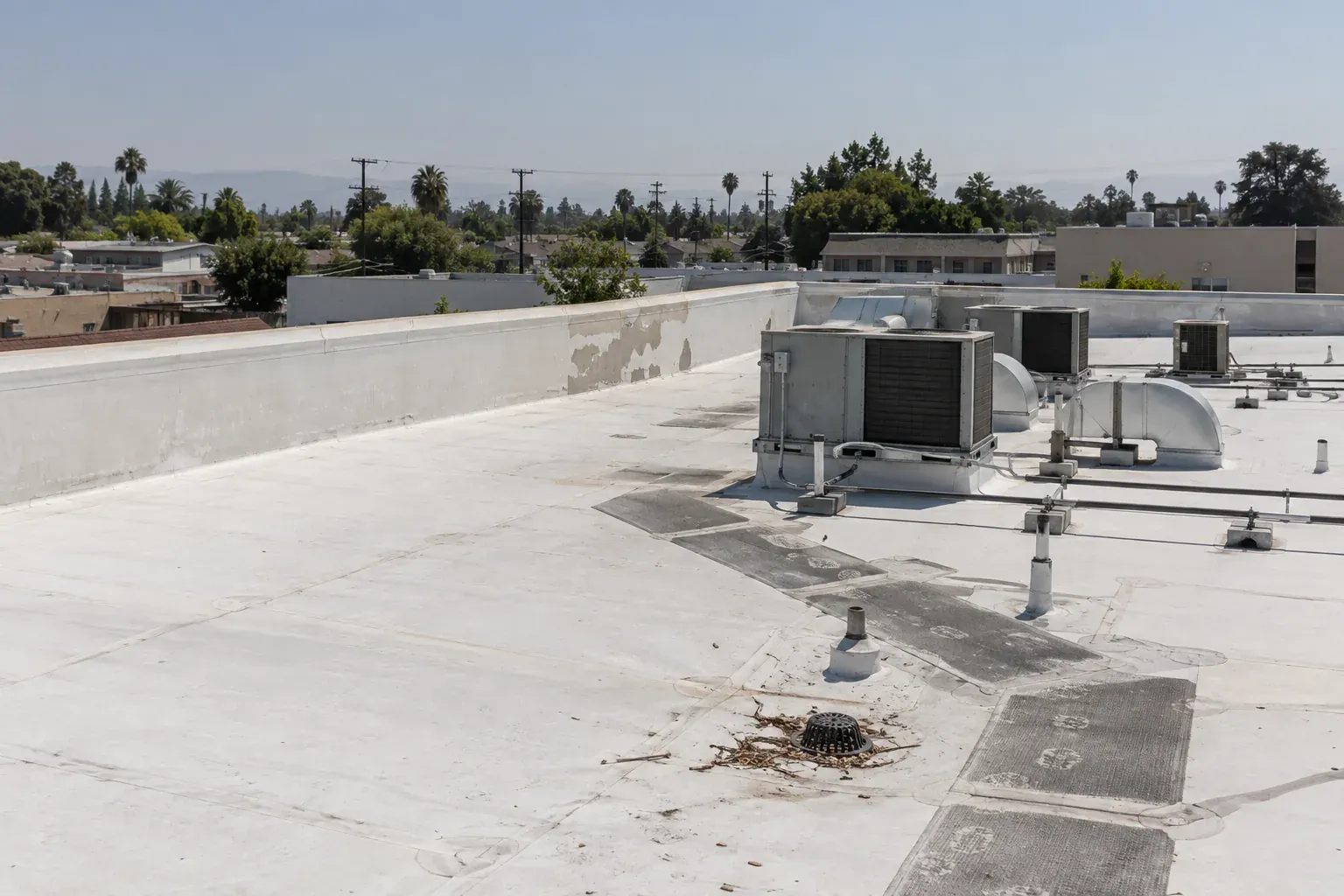
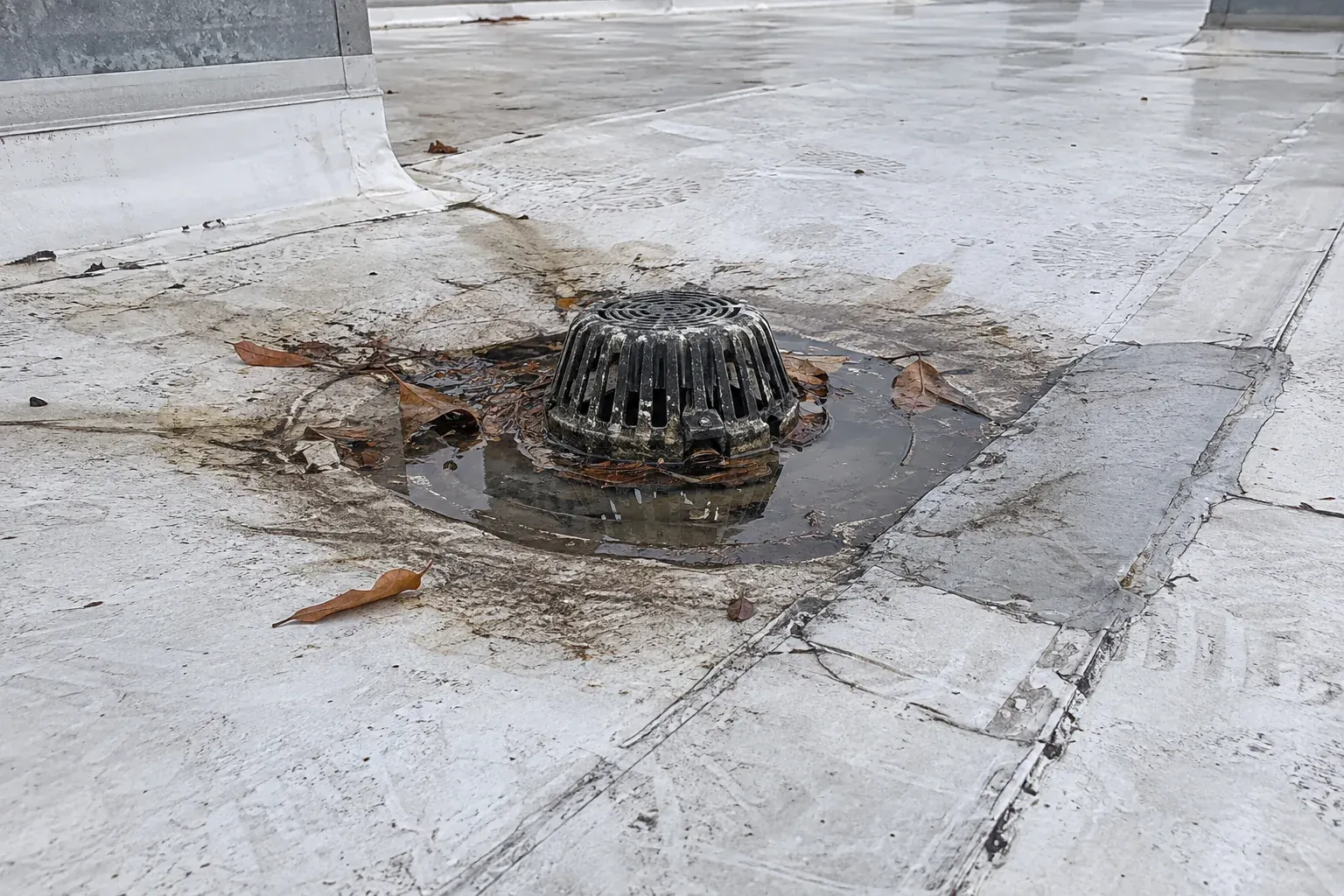
Most commercial leaks start at the same few places: seams in the membrane, flashing around HVAC curbs and rooftop units, parapet walls, and roof drains or scuppers that clog and let water pond. A repair visit finds where the water gets in, which is often several feet from where it shows up on the ceiling. It seals that point and checks whether the insulation underneath has soaked up water. If it has, patching the surface alone just hides the problem. See roof repair in Los Angeles for leak response and emergency service.
Roof Restoration and Coatings
If the membrane is aged but still watertight and the insulation is mostly dry, a restoration can add years of service at a fraction of the cost of replacement. It means cleaning, repairing the seams and flashing, and applying a silicone or acrylic coating. Many coatings also count as a cool-roof surface under California's energy code.
Commercial Roof Replacement (Tear-Off and Recover)
When the membrane has failed or a large share of the insulation is wet, replacement is the only lasting fix. A tear-off removes the existing roof down to the deck. A recover (overlay) installs a new system over the old one where code and the existing layers allow it. The right choice depends on how many roofs are already on the building, whether the deck is sound, and your budget horizon.
Flat Roofing, TPO and Foam Roofing Installation
New low-slope roofs in TPO, PVC, modified bitumen, spray foam or metal, with cool-roof-rated products that meet Title 24.
Inspections and Preventive Maintenance Plans
Twice-yearly inspections catch small failures before the rainy season turns them into interior damage. One inspection before winter and one after is the usual rhythm. A maintenance plan covers clearing drains, checking seams and flashing, resealing penetrations, and a written condition report you can put in front of owners or lenders.
Repair, Restore, or Replace? How to Decide
The most expensive mistake in commercial roofing is replacing a roof that could have been restored, or patching one that needed replacing a year ago. This is how the decision usually breaks down:
Roof condition and the fix it usually points to. Select a condition to highlight its signal.
Condition
Usually points to
Repair
Restoration / coating
Replacement
Replacement (at least of the wet areas)
Tear-off
Repair or restoration
NoticeRepair
CautionRestore
WarningReplace
Ponding at a clogged drain: a common source of leaks and wet insulation
The only way to know the insulation condition is to test it. An infrared moisture survey or core cuts show whether water is trapped under the membrane. Any contractor who recommends a full replacement without checking is guessing.
Not sure which row your roof falls in? Describe the building and a contractor will tell you which fix it points to.
Commercial Roofing Systems for LA Buildings
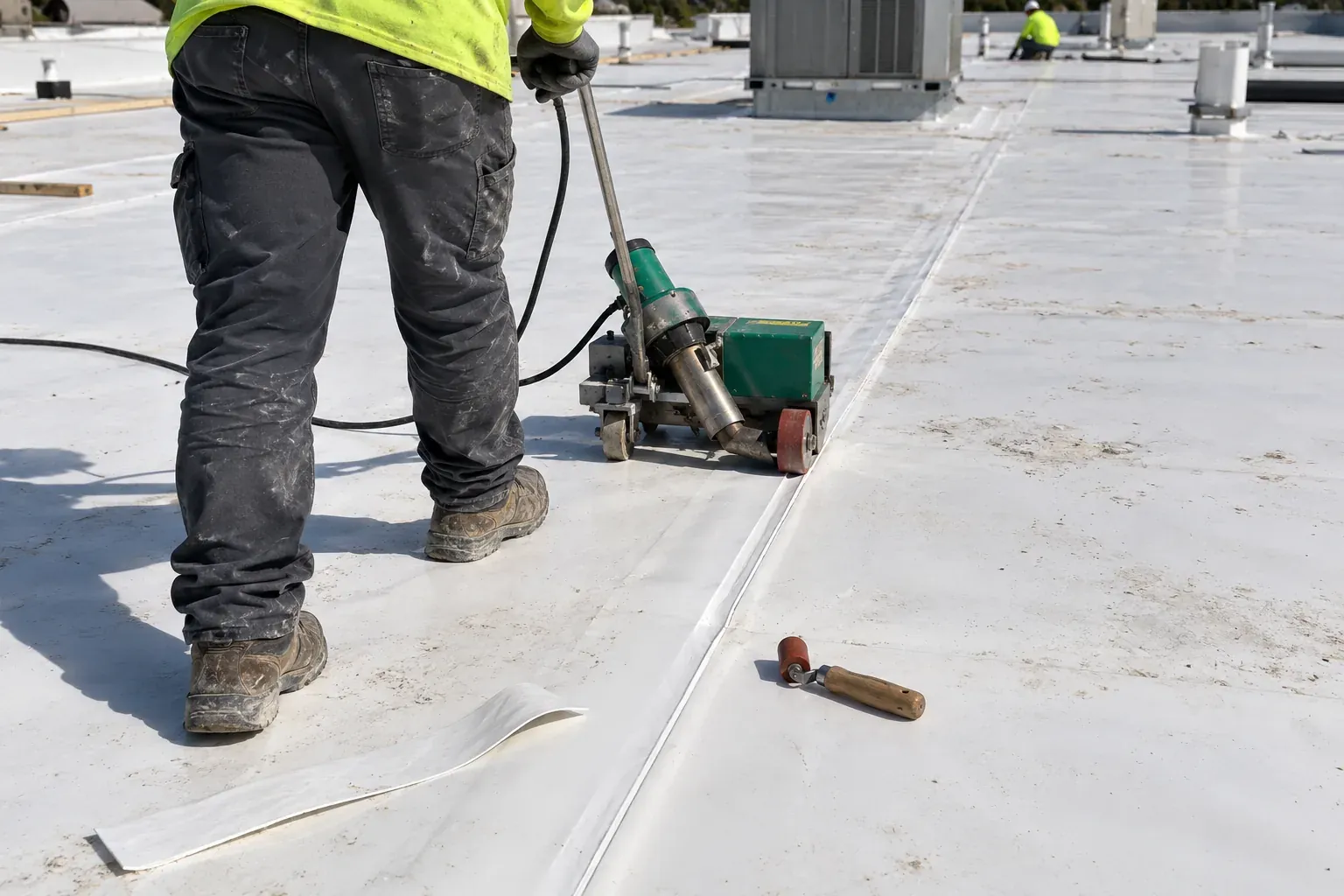
Where commercial roofs leak: seams in the membrane, flashing at walls and curbs, and drains that let water pond. Illustrative diagram, not to scale.TPO seams are heat-welded, not glued
TPO Roofing and PVC Membranes
TPO and PVC are the most common choices for new low-slope roofs in Southern California. Both are light-colored, heat-welded membranes that reflect sunlight and are available in cool-roof-rated versions. PVC holds up better where rooftop exhaust carries grease or chemicals, which makes it common on restaurants. TPO is typically the more economical choice for warehouses and large, simple roofs.
Modified Bitumen and Built-Up Roofing
Modified bitumen (torch-down or cold-applied) and traditional built-up roofing (BUR) use multiple layers, so they're thick and tough under foot traffic. Many older LA commercial and multifamily buildings already have one of them. When that's the case, they're often the starting point for a restoration rather than a tear-off.
Foam Roofing (SPF) and Silicone Coatings
Spray polyurethane foam goes on as a liquid, forms a seamless insulated layer, and is finished with a protective coating. It suits roofs with lots of penetrations or irregular shapes. Silicone coatings are the most common restoration topcoat on existing membranes and resist ponding water well.
Metal Roofing for Commercial Buildings
Standing-seam metal is used on low-slope and pitched commercial roofs where long life and fire resistance matter. Existing metal roofs can often be restored with seam sealing and a coating instead of being replaced.
Los Angeles Code, Permits and Cool Roof Requirements
Title 24 Cool Roof Rules
Under California's Energy Code (Title 24, Part 6, §141.0; the 2025 code applies to permits applied for since January 1, 2026, and the reroof values are unchanged from 2022), a nonresidential low-slope reroof in any climate zone needs a cool roof when more than 50% of the roof or more than 2,000 sq ft, whichever is less, is altered. Multifamily low-slope reroofs are covered in climate zones 2, 4 and 6 through 15 with the same trigger. The product must reach aged solar reflectance 0.63 and thermal emittance 0.75, or SRI 75, rated by the Cool Roof Rating Council. There are limited exceptions for heavy roof assemblies and insulation tradeoffs.
Los Angeles Department of Building and Safety (LADBS) Re-Roof Permits
Reroofing more than 100 sq ft in the City of Los Angeles requires a permit from the Department of Building and Safety (LADBS), and an inspection is required after tear-off (or before a recover). Other cities in LA County, such as Vernon, Commerce and Long Beach, issue their own. A contractor should pull the permit as part of the job. If a bid leaves the permit out, ask why.
The "25% Rule"
There's no single rule by that name. The California Building Code has reroof area provisions, and LA County allows in-kind sheathing replacement up to 25% of the roof without a permit for single-family homes, duplexes and townhouses only. LADBS doesn't publish a 25% trigger, so ask LADBS or your city's building department before approving a large repair, and don't rely on the folklore. See our roofing permits guide. Residential work, from single-family reroofs to small rentals, is covered on Roofing Los Angeles.
What Does a Commercial Roof Cost in Los Angeles?
System
Installed, per sq ft (national range)
TPO
~$4–$9.50
PVC
~$5–$11
EPDM
~$3.50–$8.50
Modified bitumen
~$4–$9
Built-up roofing (BUR)
~$4–$10.50
Spray foam (SPF)
~$5–$10
Silicone coating restoration
~$1.50–$7
Acrylic coating restoration
~$0.50–$3.50
Typical national ranges reported by roofing cost guides (2025–2026). No LA-specific commercial ranges are published, so get local quotes.
Commercial roofing is priced per square foot. The number moves with a few factors:
Scope: repair vs restoration vs recover vs full tear-off
System: TPO, PVC, mod-bit, SPF or coating
Roof size and access: crane or hoist needs, building height, staging on a busy street
Condition: how much wet insulation and damaged deck has to be replaced
Penetrations: HVAC units, skylights, vents and drains that need flashing
Warranty: a manufacturer NDL warranty requires certified installers and inspections, which adds cost
Is $30,000 too much for a roof?
It depends entirely on size and scope. At the ranges above, $30,000 buys a full replacement of only a small commercial roof, or a coating restoration on a much larger one. Ask for the price per square foot and a line-item scope, then compare bids on the same scope.
How Long Does a Commercial Roof Last?
Lifespan depends on the system, how it was installed, and how well it's maintained. Regular inspections and drain clearing keep a roof toward the top of its range, and a coating restoration can add years to an aging membrane.
System
Typical lifespan
TPO
15–25 years
PVC
20–30 years
EPDM
15–25 years
Modified bitumen
15–25 years
Built-up roofing
20–30 years
Metal
40–60 years
Industry consensus ranges.
What Our Customers Say
How to Choose a Commercial Roofing Contractor in Los Angeles
Whichever commercial roofing company you hire, check these six things first.
Check the licenseRoofing contractors in California need a C-39 license from the Contractors State License Board. Look it up at cslb.ca.gov and confirm it's active.
Get insurance certificatesAsk for workers' compensation and general liability, sent by the insurer rather than as a PDF from the contractor.
Ask about manufacturer certificationOnly certified installers can offer the manufacturer's NDL warranty on TPO, PVC and coating systems.
Get a written scopeIt should cover the system, insulation, flashing details, drains, permit, clean-up and warranty terms, separately from the price.
Ask for commercial referencesBuildings similar in size and type to yours, ideally with a property manager you can call.
Ask how they found the problemA good contractor explains how they diagnosed the roof (infrared scan, core cuts) instead of only quoting a replacement.
Buildings This Covers
Warehouses & distribution
Light industrial & manufacturing
Retail & strip centers
Restaurants
Office buildings
Multifamily & apartments
HOA & condo complexes
Schools & churches
Areas Covered
Downtown LA
Vernon
Commerce
City of Industry
Santa Fe Springs
Carson
Gardena
Torrance
El Segundo
Long Beach
Van Nuys
Sun Valley
Chatsworth
Burbank
Glendale
Pasadena
Commercial Roofing FAQs
How much does a commercial roof cost?
Typical published national ranges per square foot installed: TPO about $4 to $9.50, PVC $5 to $11, EPDM $3.50 to $8.50, modified bitumen $4 to $9, built-up roofing $4 to $10.50 and spray foam $5 to $10. Coating restorations run about $0.50 to $7 per square foot depending on the coating and substrate.
What is considered commercial roofing?
Commercial roofing covers the roofs of non-residential and larger multi-unit buildings: warehouses, retail, offices, industrial and apartment buildings. These are usually low-slope ("flat") roofs using membranes, built-up systems, foam or coatings rather than the shingles and tile typical of houses.
What type of roof is best for commercial buildings in Los Angeles?
There's no single best system. TPO is common for large, simple roofs. PVC suits restaurants and roofs exposed to grease or chemicals. Coatings and spray foam work well for restorations and roofs with many penetrations. In LA the choice also has to meet Title 24 cool-roof requirements.
How many years does a commercial roof last?
Typical industry ranges: TPO 15 to 25 years, PVC 20 to 30 years, EPDM and modified bitumen 15 to 25 years, built-up roofing 20 to 30 years and metal 40 to 60 years. Twice-yearly inspections and drain maintenance keep a roof toward the top of its range.
What are the three types of commercial roofing?
Most low-slope commercial roofs fall into three families: single-ply membranes (TPO, PVC, EPDM), multi-layer bituminous systems (modified bitumen and built-up roofing), and fluid-applied systems (spray foam and roof coatings). Metal roofing is a fourth option on some buildings.
Do cool roof rules apply to a commercial reroof in Los Angeles?
Yes. Under California's Energy Code (Title 24, Part 6, section 141.0), nonresidential low-slope reroofs in every climate zone need a cool roof when more than 50% of the roof or more than 2,000 square feet, whichever is less, is altered: aged solar reflectance 0.63 and thermal emittance 0.75, or SRI 75, with limited exceptions. The 2025 code applies to permits applied for since January 1, 2026, and the reroof values are unchanged from 2022.
Who is responsible for roof repairs in a commercial lease?
It depends on the lease. Under many triple-net (NNN) leases the tenant pays, directly or through common-area charges. Under gross leases the landlord usually does. Check the maintenance and repair clauses, and document the roof's condition at the start of the lease.
Do I need a permit to replace a commercial roof in Los Angeles?
Reroofing more than 100 sq ft in the City of Los Angeles needs a permit through LADBS, and other LA County cities have their own building departments. Your contractor should pull the permit and schedule the inspections.
How do you choose a commercial roofing contractor?
Check for an active CSLB C-39 license, get insurance certificates directly from the insurer, ask whether they are certified by the membrane manufacturer, insist on a written line-item scope, call commercial references on similar buildings, and ask how they diagnosed the roof before quoting.
Ready to find out what your roof actually needs?
Tell us about the building: type, rough roof size, the roof system if you know it, and what's happening. The contractor should come back with a written condition report and a clear repair, restore or replace recommendation.