Re-Roofing with Solar PanelsWhat to Know Before You Start
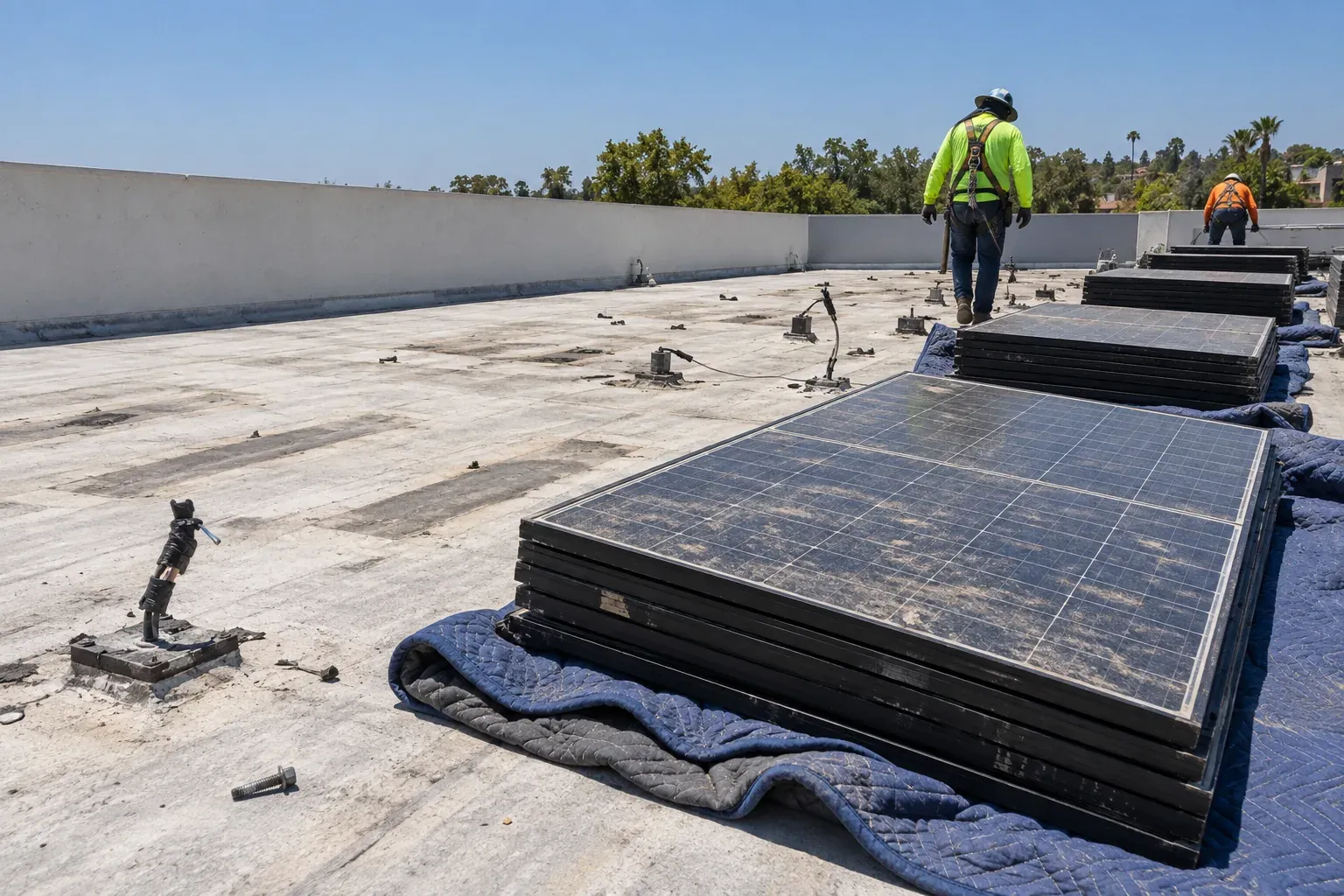
A roof with solar panels on it doesn't get skipped when it's time to reroof; the panels come off, the roof gets replaced underneath, and the panels go back on.
Standard practice on a house with existing solar is: a licensed solar professional shuts down the system and disconnects it, the panels and racking come off, the roofer replaces the roofing underneath, and the solar crew reinstalls and re-energizes the array. Skipping the removal and roofing over or around an existing array isn't a shortcut worth taking; it risks damaging the panels, can void roofing warranties on the affected area, and makes it far harder to diagnose a leak later. If you're seeing a leak around existing panels right now, see roof repair in Los Angeles. Send Roofing Los Angeles a note and a roofer can scope the roofing side of that sequence.
Timing between the two trades matters. A standard asphalt-shingle reroof typically takes the solar system offline 2 to 4 weeks; a tile reroof can take up to 6 weeks offline. Most of that is scheduling and permitting rather than hands-on-roof time: the actual construction is often only 1 to 5 working days. Coordinating one company to manage both trades, or getting firm dates from each separately, keeps the system offline for as little time as possible.
Reroof Before a New Solar Install If Your Roof Is Older
If your roof already needs attention, doing the reroof before a new solar system goes on avoids paying to remove and reinstall panels that are only a few years old. If the roof has plenty of life left, there's no need to replace it just to add solar.
Net Metering & Interconnection Notes
LADWP Territory
LADWP customers remain on retail-rate net metering, managed independently of the state's NEM 3.0 rules. LADWP charges a $130 interconnection expenditure-recovery fee at submittal for PV projects, and systems of 30kW or less, single-phase, pay no more beyond that fee.
SCE Territory: Confirm Before You Schedule
In SCE territory, a temporary removal and reinstall for roofing purposes doesn't typically trigger a new interconnection application if the system's size and location are unchanged, but SCE's rules are the final word. Ask your solar installer to confirm directly with SCE that the reinstall will be processed as a restoration rather than a new interconnection, since a new interconnection could move an older, legacy NEM system onto current export rates. Any change to system size, inverter, or roof plane may also require an amended interconnection application.
Not sure where your roof stands with solar already installed? Send us a note.
The Federal Solar Tax Credit Has Ended for New Installations
The federal 25D residential Clean Energy Credit, the 30% solar credit, was ended by the One Big Beautiful Bill Act, signed July 4, 2025. Solar property, including panels, had to be installed and placed in service on or before December 31, 2025 to claim the credit; anything placed in service January 1, 2026 or later is not eligible. Ordinary roof replacement never qualified for this credit on its own, and only counted in limited cases as a minor incidental cost tied directly to a qualifying solar installation.
“Free Roof With Solar” Offers
Some solar companies bundle a roof replacement into a solar financing package and market it as a free roof. It isn't free; the cost is built into the financing terms one way or another. Read the loan or lease agreement closely, ask what happens to the roof warranty if you stop paying or switch providers, and get the roofing scope itself in writing separately from the solar contract.
Solar Shingles: An Alternative
Solar shingles build photovoltaic cells into the roofing material itself instead of mounting separate panels on top of it. GAF Timberline Solar is one example: it runs roughly $21 to $24 per square foot of roof and can be nailed down much like a standard asphalt shingle, which simplifies installation compared with most competing solar-shingle products. Other solar shingle products exist at different price points; confirm current pricing, availability and installer network directly with the manufacturer, since this is a fast-moving product category. See our roofing materials guide for how solar shingles stack up against conventional asphalt shingle, tile and metal.
Roofer vs. Solar Installer: Two Warranties
The roofing warranty and the solar installation warranty come from two separate companies and typically cover only their own scope. Get it in writing up front who's responsible if a panel is damaged during removal, or if a leak develops at a penetration point after the panels go back on.
Solar Re-Roof FAQs
Do solar panels need to come off before a reroof?
Yes. Standard practice is to remove the panels, replace the roof underneath, then reinstall the system. Trying to work around the panels instead of removing them usually costs more in the long run and risks damaging both the roof and the array.
How much does it cost to remove and reinstall solar panels for a reroof?
National figures put it at roughly $200 to $300 per panel, or about $2,800 to $4,800 total for a 14 to 16 panel system. Get an itemized quote from the solar installer, since your system size and panel count set the real number.
How long will my solar system be offline during a reroof?
A standard asphalt-shingle reroof typically takes the system offline 2 to 4 weeks; a tile reroof can take up to 6 weeks offline. The active on-roof construction itself is often only 1 to 5 working days, with the rest of the time going to permitting and scheduling.
Should I replace my roof before installing solar?
If the roof is old or near the end of its material's life (3-tab shingle 20 to 30 years, architectural 30 to 45, tile underlayment often much sooner), reroof first. Otherwise you pay to detach and reset a new system a few years later, roughly $200 to $300 per panel, or about $2,800 to $4,800 for 14 to 16 panels (national figures). If the roof has plenty of life left, there's no need to replace it just because you're adding solar.
Does removing and reinstalling solar panels affect my net metering agreement?
It depends on your utility. LADWP customers remain on retail-rate net metering, managed separately from the state's NEM rules, with a flat interconnection fee for PV projects. In SCE territory, a temporary removal and reinstall for roofing doesn't typically require a new interconnection application if the system's size and location stay the same, but confirm with SCE that the work is processed as a restoration, since a new interconnection could move an older system onto current export rates.
Does the federal solar tax credit cover roof replacement done with a solar install?
Ordinary roof replacement never qualified for the federal 25D solar tax credit, except in limited cases as a minor incidental cost tied directly to the solar installation. The 25D credit itself ended for solar property placed in service after December 31, 2025, following the One Big Beautiful Bill Act.
What are solar shingles, and how much do they cost?
Solar shingles integrate photovoltaic cells into a roofing product instead of mounting separate panels on top of conventional roofing. GAF Timberline Solar shingles run roughly $21 to $24 per square foot of roof and can be nailed down much like standard asphalt shingles. Confirm current product availability and installer network directly with the manufacturer before assuming a specific brand is an option for your project.
Whose warranty covers damage during a reroof-and-reinstall, the roofer's or the solar company's?
Get this in writing before work starts. The roofing warranty and the solar installation warranty are separate, from separate companies, and each typically covers only their own scope of work. Ask both companies directly who is responsible if a panel is damaged during removal or if a leak develops at a penetration after reinstallation.
Reroofing around an existing solar system?
Tell us your roof type, roughly how many panels, and whether the roof or the solar came first. A roofer can then tell you what to check before you schedule anyone.