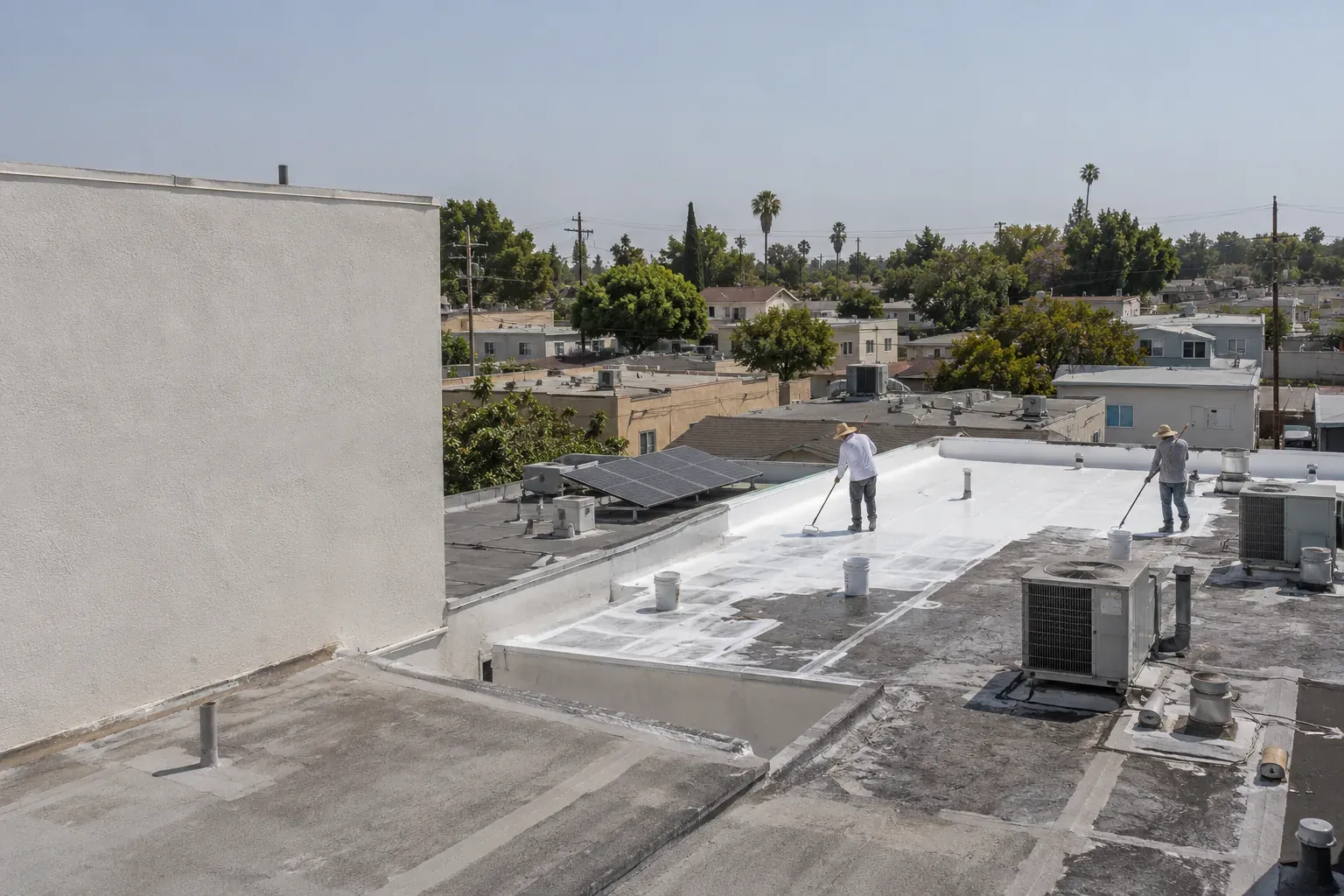
Title 24 Cool Roof Requirementsand the LADWP Rebate
Many reroofs in Los Angeles hit a cool-roof requirement, but whether one applies depends on the building type, the roof's slope, and which of LA's three climate zones it sits in. The thresholds themselves are the same in every zone the rule covers.
Cool Roof Requirements by Building Type, Slope & Climate Zone
The City of Los Angeles spans three Title 24 climate zones: CZ 6 (coastal, including the Westside), CZ 8 (South and East LA, Inglewood, Culver City and inland South Bay ZIP codes) and CZ 9 (the San Fernando Valley). LA County reaches into CZ 14 and 16 in the mountains. Torrance ZIPs 90504 and 90506 and Long Beach ZIPs 90805, 90807 and 90808 are CZ 8. The California Energy Commission's climate-zone lookup is the authority for any specific parcel; the zone only decides whether a rule applies, not what the minimums are.
Building type
Roof slope
Zones where the rule applies
In LA (zones 6, 8 & 9)
Minimum (aged SR / TE / SRI)
Trigger
Single-family
Steep-slope (2:12 or steeper)
4, 8–15
Zones 8 and 9 only; coastal zone 6 has no requirement
0.20 / 0.75 / 16
Reroof of the building
Single-family
Low-slope
4, 6–15
Zones 6, 8 and 9
0.63 / 0.75 / 75
Reroof of the building
Multifamily
Low-slope
2, 4, 6–15
Zones 6, 8 and 9
0.63 / 0.75 / 75
More than 50% of the roof or more than 2,000 sq ft, whichever is less, is altered
Each rule above carries exceptions. Nonresidential: low-U-factor tradeoffs, BIPV-covered areas, and roof assemblies of 25 lb/ft² or more. Single-family steep-slope: R-38 ceiling insulation (or U-factor of 0.025 or lower), a radiant barrier, no attic ducts in some zones, or roofs of 25 lb/ft² or more. Single-family low-slope: roof-deck insulation can substitute. A contractor familiar with Title 24 compliance forms can tell you whether your project qualifies for one.
SR, TE & SRI, Explained
Solar reflectance (SR) is the share of sunlight the roof reflects rather than absorbs, tested at a 3-year-aged value. Thermal emittance (TE) is how well the material releases absorbed heat. Solar Reflectance Index (SRI) combines both into a single number. All three are tested and certified by the Cool Roof Rating Council, and a compliant product carries a CRRC label showing them.
The 2025 Code and What a Contractor Submits
California's Energy Code runs on cycles. The 2025 Energy Code has applied to permits applied for since January 1, 2026, and the CRRC's 2025 summary chart (dated December 4, 2025) shows the reroof cool-roof values unchanged from the 2022 cycle. The table above is current. The permit itself is still where the exact numbers for your building are confirmed.
On the permit package, the roofing product's CRRC Product ID and its rated solar reflectance, thermal emittance and SRI get documented against the code minimum for your building type, slope and climate zone. That's the paper trail an inspector checks.
Commercial Follows the Nonresidential Rule
If you manage a warehouse or retail building, the nonresidential low-slope rule applies, not the single-family thresholds above. It's the broadest: every climate zone, triggered when more than 50% of the roof or more than 2,000 sq ft (whichever is less) is altered. Multifamily buildings have their own rows in the table, with the same trigger. See commercial roofing in Los Angeles for how that plays into a coating restoration or reroof. Homeowners replacing a steep-slope roof can start from Roofing Los Angeles for the residential side.
Not sure whether your reroof needs a cool-roof product, or which one qualifies? Send us a note before you buy material.
The LADWP Cool Roof Rebate
LADWP's residential Consumer Rebate Program includes a cool roof rebate.
Item
Detail
Base rebate
$0.20 per sq ft
Enhanced rebate
Up to $0.60 per sq ft for higher-SRI qualifying products
Household cap
$1,800
Eligibility
Active LADWP residential electric service; product meets LA Green Building Code's 3-year-aged SRI standard per CRRC
Area covered
Conditioned-space roof area only; patios, carports and unconditioned overhangs excluded
How to apply
Paid itemized invoice showing the CRRC Product ID, the final approved permit, and your LADWP bill, postmarked within 12 months of purchase
Commercial
Routes through LADWP's separate Custom Performance Program, not this residential rebate
LADWP Consumer Rebate Program and LADWP CRP Fact Sheet. Funds are first-come, first-served and can run out; confirm current terms on LADWP's own page before applying.
Title 24 & Cool Roof FAQs
What qualifies as a cool roof under Title 24?
A roofing product rated and labeled by the Cool Roof Rating Council (CRRC) that meets the minimum aged solar reflectance and thermal emittance, combined into a Solar Reflectance Index (SRI), for your building type, roof slope and climate zone. Reflectance, emittance and SRI are the three metrics the CRRC tests and certifies.
Do LA's coastal areas have different cool-roof rules than the rest of the city?
For steep-slope single-family reroofs, yes. The steep-slope cool-roof rule applies in climate zones 4 and 8 through 15, which covers zone 8 (South and East LA, Inglewood, Culver City, inland South Bay) and zone 9 (San Fernando Valley) but not coastal zone 6, so a steep-slope single-family reroof in zone 6 has no cool-roof requirement. Single-family low-slope reroofs are covered in zones 4 and 6 through 15, and nonresidential low-slope reroofs in every zone. The thresholds are the same wherever a rule applies. The CEC's climate-zone lookup settles any specific parcel.
Does the 2025 Energy Code change the cool-roof requirements for a reroof?
Not for reroof values. The 2025 Energy Code has applied to permits applied for since January 1, 2026, and the CRRC's 2025 summary chart (dated December 4, 2025) shows the reroof cool-roof values unchanged from the 2022 cycle.
Is the LADWP Cool Roof Rebate still active?
Yes. LADWP offers it through its Consumer Rebate Program for residential customers, with funds first-come, first-served, so confirm current terms on LADWP's page. Commercial cool-roof projects go through a separate program, LADWP's Custom Performance Program.
How much is the LADWP Cool Roof Rebate?
A base rebate of $0.20 per square foot, rising to up to $0.60 per square foot for higher-SRI qualifying products, capped at $1,800 per household.
Am I eligible for the LADWP Cool Roof Rebate?
You need active LADWP residential electric service, and the roofing product must meet the LA Green Building Code's 3-year-aged SRI standard per CRRC. The rebate applies only to conditioned-space roof area, not patios, carports or unconditioned overhangs, and the application (with a paid itemized invoice showing the CRRC Product ID, the final approved permit, and your LADWP bill) must be postmarked within 12 months of purchase. Funds are first-come, first-served and can run out.
What does a contractor submit to prove Title 24 compliance on a reroof?
The permit package documents the roofing product's CRRC Product ID and its rated solar reflectance, thermal emittance and SRI against the code's minimum for your building type, slope and climate zone. For the LADWP rebate specifically, you'll separately need that CRRC Product ID plus the final approved permit and a paid itemized invoice.
Does a commercial reroof have different cool-roof rules than a home?
The nonresidential low-slope rule is broader than the single-family rules: it applies in every California climate zone, including all three LA zones, whenever more than 50% of the roof or more than 2,000 square feet, whichever is less, is altered, at a higher reflectance and SRI threshold than the steep-slope minimum. Multifamily buildings have their own rows, with the same trigger.
Not sure where your roof stands on Title 24?
Tell us your address or ZIP, your roof type and slope. A roofer can then confirm your climate zone and what a compliant reroof needs.