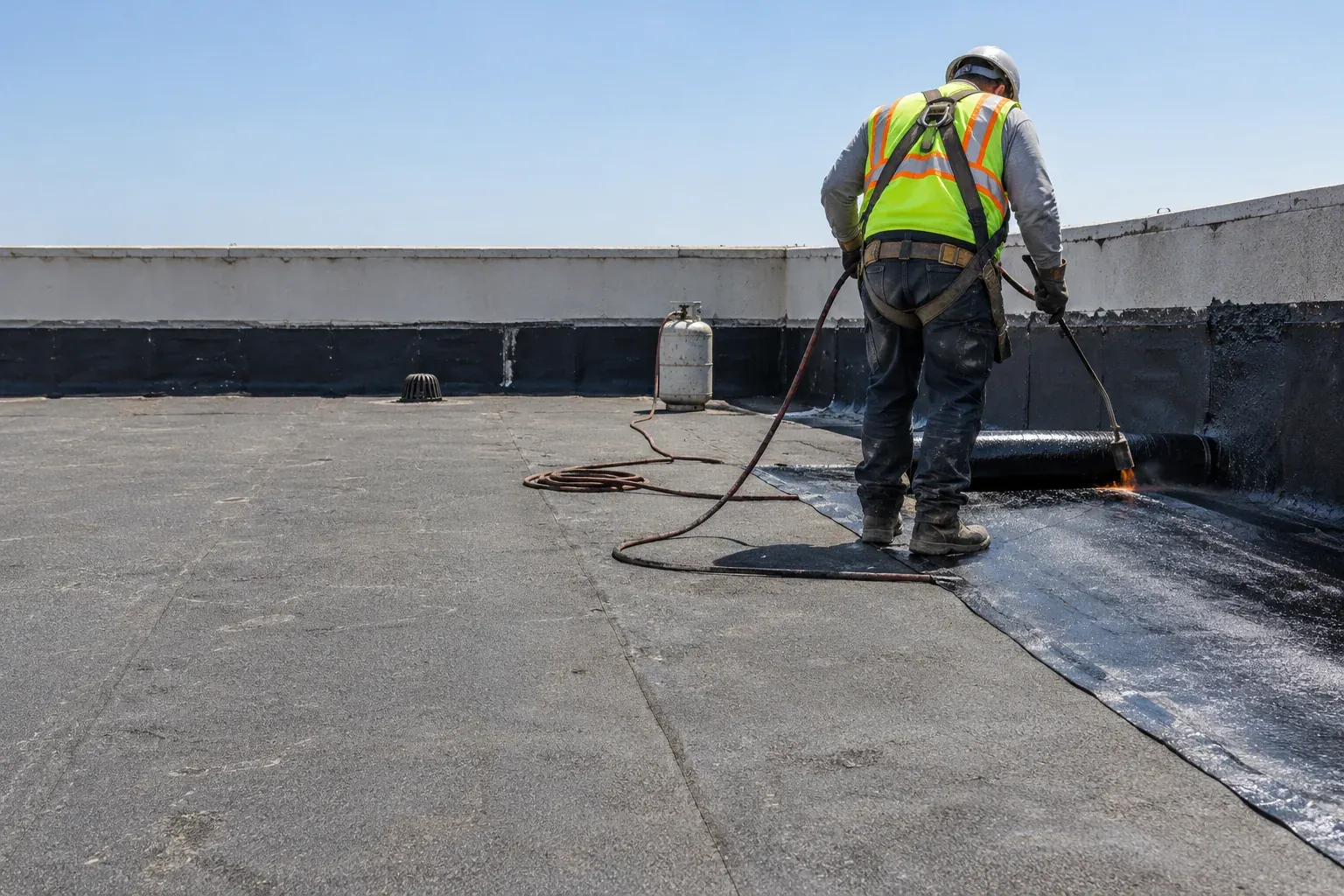
Rolled asphalt sheets heat-welded together in overlapping layers. It's tough, forgiving of foot traffic, and the most common flat-roof material on older LA homes and additions. Repairs are straightforward for a crew that does it regularly, since new material welds directly to the old.
TPO
A single-ply, heat-welded membrane, usually white or light-colored, that reflects sunlight well and is available in cool-roof-rated versions. It's common on newer additions and ADUs and holds up well with minimal maintenance when seams are welded correctly.
Spray Foam (SPF) with Elastomeric Coating
Sprayed on as a liquid that expands and cures into a seamless, fully adhered, insulated layer, then finished with a protective elastomeric topcoat. It's well suited to roofs with lots of penetrations or an irregular shape, where a seam-based membrane would have more joints to fail. It needs periodic recoating to stay watertight over the long run.
Hot Mop (Built-Up Roofing)
The traditional multi-layer, tar-and-gravel system found on a lot of older LA flat roofs. Many are still in service, and a hot mop roof nearing the end of its life is often a candidate for a coating restoration rather than an immediate tear-off, the same logic used on commercial built-up roofs.
Why Flat Roofs Need Different Care
A pitched roof sheds water in minutes. A flat or low-slope roof relies on a slight built-in pitch toward drains or scuppers, and it depends on those drains staying clear. When they don't, water sits.
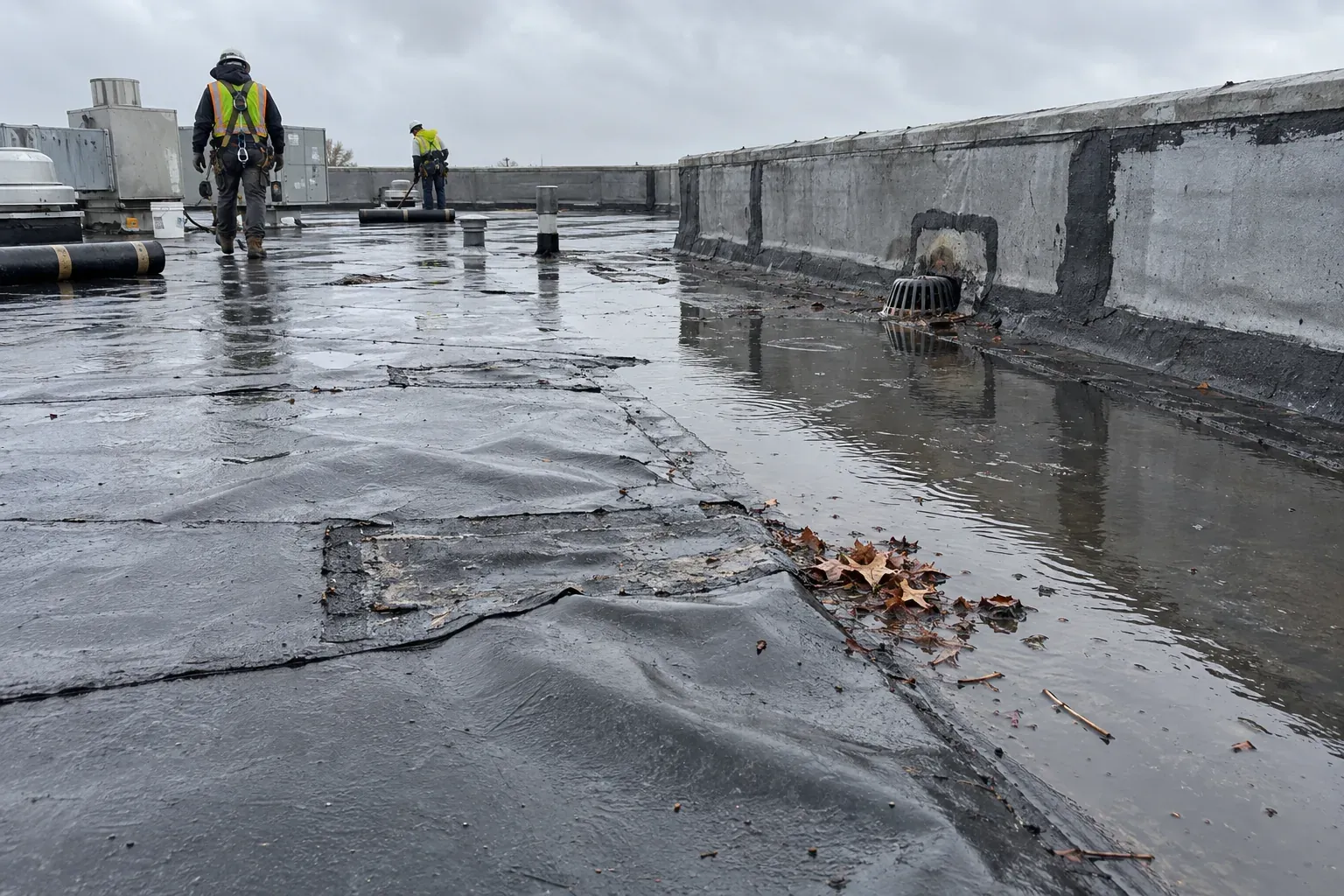
The roofing industry's own definition, from the NRCA, sets the line clearly: water remaining on the roof more than 48 hours after the most recent rain, under conditions that would otherwise allow it to dry, is ponding, not normal drainage lag. Ponding water finds every weak seam and pinhole eventually, and it's a common reason acrylic coatings fail early, since most acrylic coating warranties specifically exclude ponding conditions.
Ponding beside a drain: water still standing more than 48 hours after rain is a drainage problem, not normal lag.
Flat Roofs on ADUs and Additions
Low-slope construction shows up constantly on ADUs, garage conversions and room additions, since a flat or near-flat roof keeps the structure under height limits and simplifies tying a new roof into an existing wall line. That also means these are often the newest roofs on a property, sitting beside decades-older tile or shingle on the main house, so they age on a different schedule and can be easy to forget during a routine roof check.
Residential flat-roof pricing typically runs 20 to 40% higher per square foot than comparable commercial work, so a national commercial figure isn't a reliable stand-in for a residential quote. Always check whether insulation, tear-off and flashing are included in the number you're comparing — that alone can shift a quote by $3 to $5 per square foot. For a full-house replacement cost estimate across materials, see our roof replacement cost guide.
Cool Roof Requirement for Residential Reroofs
What Title 24 Requires
Under Title 24, a residential low-slope reroof needs a cool-roof product in Climate Zones 4 and 6 through 15 — which covers all three LA climate zones (6, 8 and 9), so this rule applies to essentially every flat residential reroof in the city, regardless of neighborhood. The threshold is aged solar reflectance 0.63, thermal emittance 0.75, or SRI 75, rated by the Cool Roof Rating Council. The 2025 Energy Code applies to permits applied for since January 1, 2026, and the reroof values are unchanged from the 2022 cycle; the California Energy Commission's climate-zone lookup is the authority for any parcel. See our full Title 24 cool roof rules guide for the details and the LADWP rebate.
Repair. A single seam split, a torn flashing at a penetration, or an isolated blister, with the membrane sound everywhere else.
Recoat / restore. The membrane is aged and chalking but still watertight, and there's no significant wet insulation underneath — a silicone or elastomeric recoat can add years of service.
Replace. Widespread membrane failure, multiple leak points, or wet insulation found once a section is opened up. Patching a roof in this condition just moves the next leak somewhere else.
Repairs that turn out to be flashing at a wall or parapet rather than the membrane field are covered under roof repair in Los Angeles. If a flat section isn't the right call for a full re-roof, see Roofing Los Angeles for the rest of your options.
Larger low-slope roofs on warehouses, retail and office buildings use the same core systems — TPO, modified bitumen, spray foam — but at a different scale, with different Title 24 triggers and typically lower cost per square foot than residential work. For warehouses, retail, offices and larger multifamily buildings, see commercial roofing in Los Angeles.
Flat Roofing FAQs
What is flat roofing called?
"Flat roof" and "low-slope roof" both cover the same family of systems: torch-down or modified bitumen, TPO and other single-ply membranes, spray polyurethane foam (SPF) with an elastomeric coating, and older hot-mopped built-up roofing. None of these are truly flat — they're built with a slight pitch toward drains or scuppers so water moves off.
How much does a flat roof cost in Los Angeles?
No LA-specific flat-roof range is published, so these are national ranges. Modified bitumen (torch-down) typically runs about $4 to $9 per square foot installed, TPO about $4 to $9.50, and spray foam with an elastomeric coating about $5 to $10. Residential flat-roof work typically prices 20 to 40% higher per square foot than comparable commercial work.
Is a flat roof less expensive than a pitched roof?
Not necessarily. A flat roof can use less material for the same footprint, but residential low-slope work prices 20 to 40% higher per square foot than comparable commercial flat roofing, and the total also depends heavily on whether insulation, tear-off and flashing are included in the quote — a difference that can run $3 to $5 per square foot on its own.
What counts as roof ponding, and is it a problem?
The roofing industry (NRCA) defines ponding as water remaining on the roof surface more than 48 hours after the most recent rain, under conditions that would otherwise allow it to dry. Water that drains off within that window is normal; water still standing after 48 hours points to a drainage problem worth correcting before it becomes a leak.
What are the downsides of a flat roof?
Flat and low-slope roofs depend on drains and scuppers to shed water, so a clogged drain becomes a leak faster than it would on a pitched roof. Seams and flashing at parapets and penetrations are also higher-risk leak points, which is why membrane roofs generally need more frequent inspection than shingle or tile.
Is a cool roof required for a flat residential reroof in Los Angeles?
Yes. Under Title 24, residential low-slope reroofs need a cool-roof product in Climate Zones 4 and 6 through 15, which covers all three LA climate zones (6, 8 and 9). The 2025 Energy Code applies to permits applied for since January 1, 2026, and the reroof values are unchanged from the 2022 cycle.
Is spray foam roofing worth it?
It depends on the roof. Spray polyurethane foam forms a seamless, insulated, fully adhered surface that's well suited to roofs with lots of penetrations or irregular shapes, where seam-based membranes have more joints to fail. It needs a maintenance coating over time to stay watertight, so ask your contractor about the recoat schedule before you decide.
Get your flat roof looked at before it leaks
Tell us what you're seeing — ponding water, a soft spot, a stain on the ceiling below — and roughly what system is up there if you know it. A good roofer gives a straight answer on repair, recoat or replacement, with a written scope.