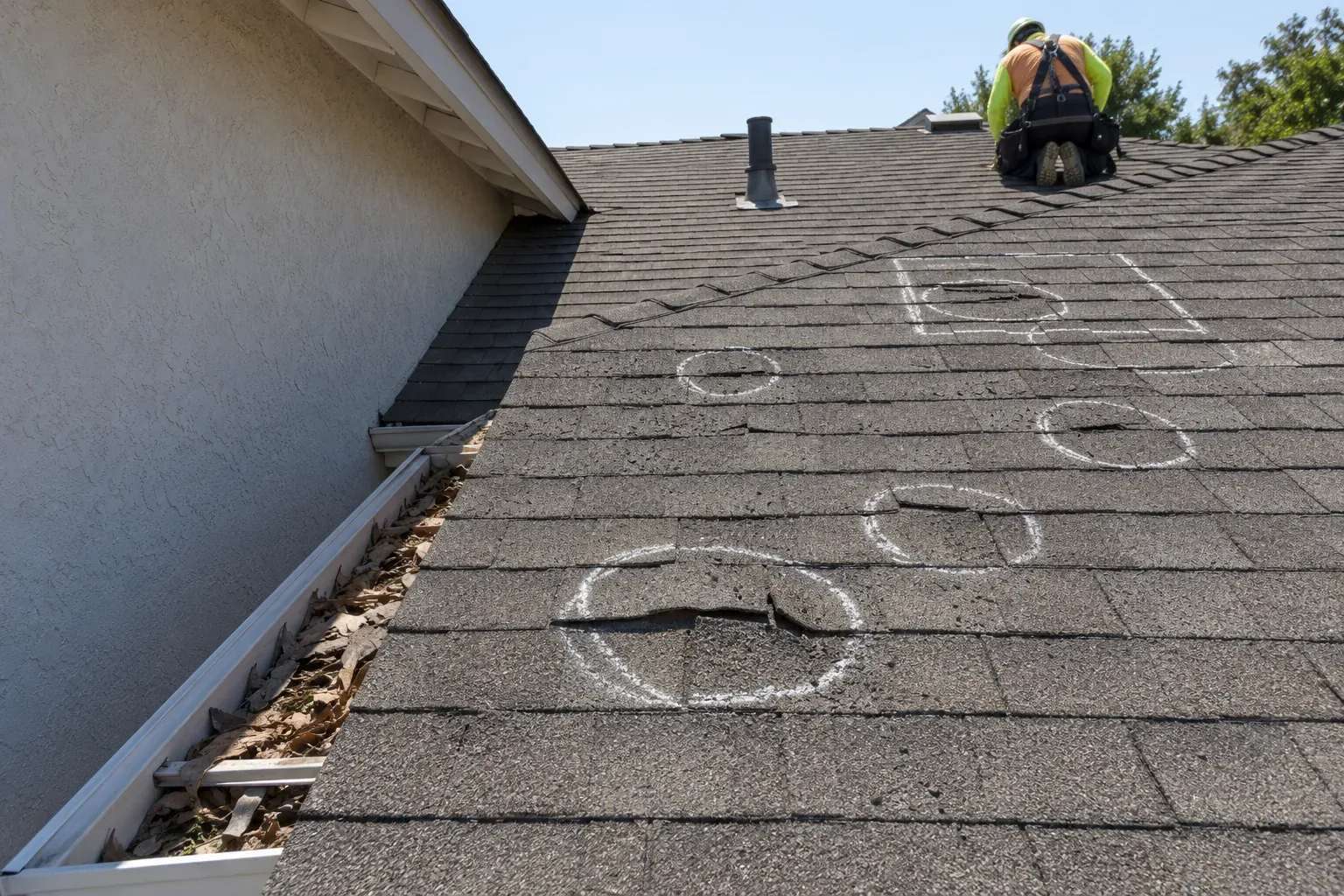
An existing California homeowners policy continues to cover an older roof for covered perils, wind, fire, tree damage, while the policy is in force. Roof age alone doesn't remove coverage from an active policy. The distinction that matters is sudden vs. gradual:
Generally covered: wind lifting tiles or shingles, a fallen branch, fire damage, hail.
Generally not covered: gradual wear, age-related deterioration, or damage from deferred maintenance.
How a covered claim gets paid also depends on the policy type:
RCV (Replacement Cost Value): pays to replace the roof with no deduction for depreciation.
ACV (Actual Cash Value): pays the depreciated value of the roof at the time of loss, which is less than replacement cost on an older roof.
Many California carriers convert older roofs from RCV to ACV at renewal, with a threshold commonly cited around 15 to 20 years, though this varies by carrier and isn't a fixed state rule. Check your own declarations page for how your roof is currently valued.
Not Legal or Insurance Advice
This page explains general coverage concepts. Your specific policy, endorsements and carrier control what's actually covered. Confirm details with your insurer or a licensed insurance professional before making a claims decision.
Older Roofs, the FAIR Plan, and the Class A Discount
The FAIR Plan's 25-Year Roof Rule
The California FAIR Plan, the state's insurer of last resort, won't provide full replacement-cost coverage on a dwelling over 25 years old unless the roof itself has been replaced within that same 25-year window. Without a dwelling replacement-cost endorsement, a total loss settles at actual cash value instead. Its standard residential policy covers four basic perils: fire, lightning, internal explosion and smoke damage, capped at a $3 million dwelling limit.
Safer from Wildfires: the Class A Discount
California's Safer from Wildfires regulation (10 CCR §2644.9), effective October 14, 2022, requires the FAIR Plan and admitted insurers that price for wildfire risk to offer documented premium discounts for home-hardening actions, including a Class A roof. Reported discount sizes are generally small, roughly under 1% up to about 5%, and apply only to the wildfire-risk portion of the premium, not the full policy. Ask your specific carrier for its filed discount rather than assuming a fixed number.
Insurer Non-Renewal on Age
California carriers can decline to renew a policy based on underwriting criteria such as roof age, provided they give proper advance notice (commonly cited at least 75 days for most homeowners policies) and follow California Department of Insurance rules. Exact age cutoffs vary by carrier and aren't published in a single public source, so ask your carrier directly rather than relying on a general rule of thumb.
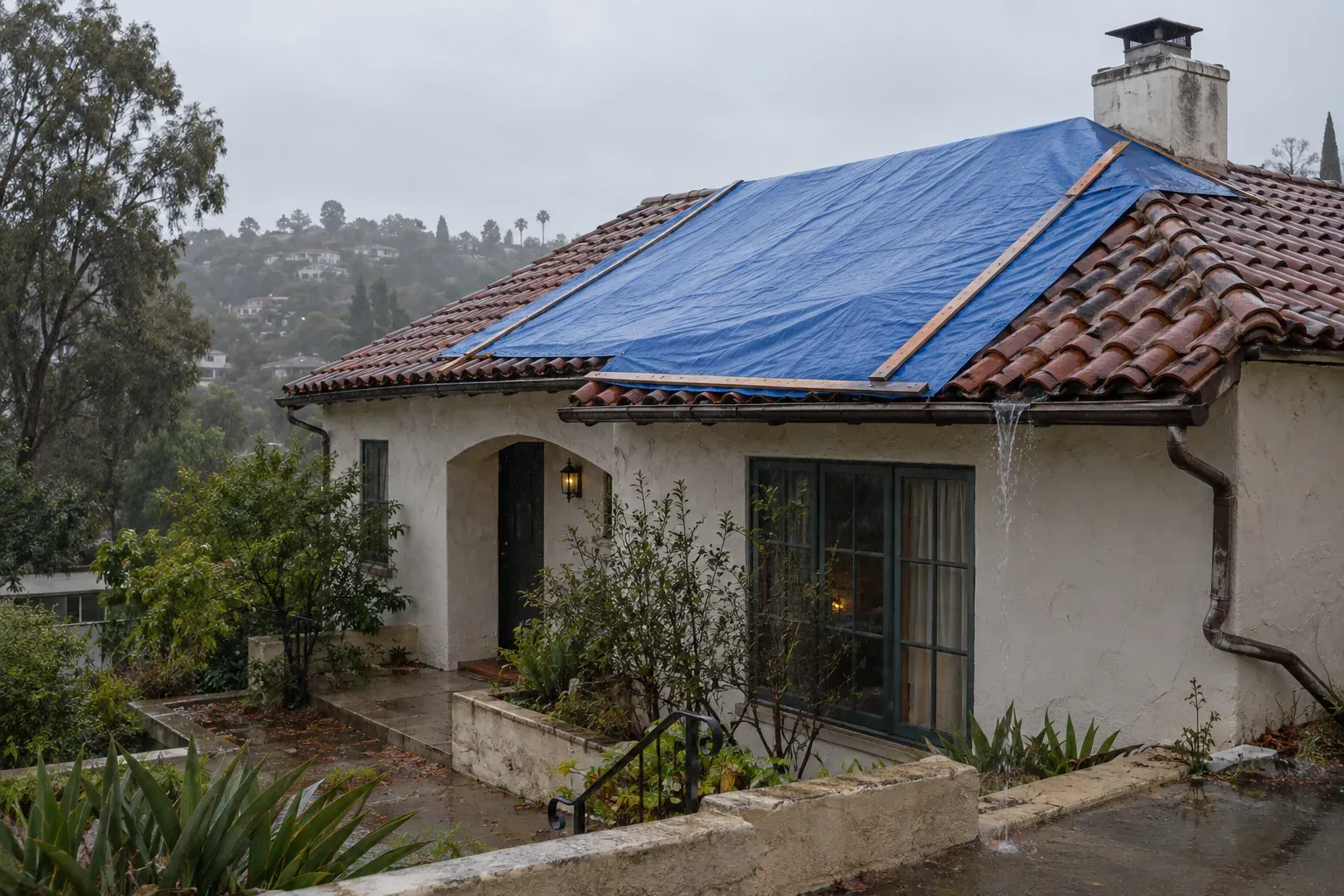
A properly secured tarp is the kind of reasonable temporary measure insurers expect after a covered loss, and its cost is typically reimbursable as part of the claim.
Documenting a Claim
If the damage is active and you need a proper fix once the claim is settled, see roof repair in Los Angeles. California's duty-to-mitigate framework expects policyholders to take reasonable temporary measures, tarping being the standard example, to prevent further damage after a covered loss. Most homeowner policies' "reasonable repairs" coverage reimburses the cost of steps taken solely to protect the property from further loss. The California Department of Insurance lists temporary repairs as one of the most important post-loss steps: ensuing damage may not be covered if you didn't take reasonable steps to secure the property.
Photograph before anything movesInterior stains, exterior damage visible from the ground, and the roof itself if it's safe to see, with timestamps.
Get a temporary tarp on quicklyEmergency tarping in LA typically runs about $250–$900. Keep the invoice; it's usually part of the claim.
Request an inspection reportA written condition report ties the damage to a specific cause and date, which strengthens the claim.
Get a written repair or replacement scopeLine-itemed, not a single lump number, so the adjuster and your contractor are working from the same document.
Before you sign anything
Be cautious with any contractor asking you to sign over your insurance check or claim proceeds before work starts. Get your own written scope and compare it against the adjuster's estimate. Send us a note about the damage, and get the written scope in hand before you commit.
Asphalt shingle (as a full assembly), concrete or clay tile, and metal roofing are the roofing types most commonly cited as qualifying for the Class A fire-rated designation that can trigger the Safer from Wildfires discount. Wood shake shingle roofs generally do not qualify as Class A. If you're weighing materials for a reroof in a fire hazard zone, ask your insurer directly which specific products on your quote qualify for their filed discount before you commit to one. See our roof replacement cost guide for what each material runs, and our emergency roof repair page if you need a tarp today. When you request a quote through Roofing Los Angeles, ask the roofer to note each product's fire rating on the written quote so you can confirm it with your insurer.
Roof Insurance FAQs
Will insurance cover a 20-year-old roof in California?
An active policy still covers sudden damage from a covered peril, such as wind or fire, regardless of the roof's age. What changes with age is how the claim is valued: many carriers settle older roofs at actual cash value (depreciated) rather than full replacement cost, with a commonly cited (though not statutorily fixed) threshold around 15 to 20 years. Check your own declarations page for how your roof is valued.
Does insurance cover roof replacement in California?
Generally yes for sudden, covered damage, such as wind lifting tiles, a fallen branch, or fire, but not for gradual wear, age-related deterioration or lack of maintenance. Whether you get replacement cost or actual cash value depends on your policy type and, on older roofs, the roof's age and condition.
What is the California FAIR Plan, and does it cover roof replacement?
The FAIR Plan is California's insurer of last resort for homes that can't get coverage in the standard market. Its standard residential policy covers four basic perils: fire, lightning, internal explosion and smoke damage, capped at a $3 million dwelling limit. On roofs specifically, the FAIR Plan won't provide full replacement-cost coverage on a dwelling over 25 years old unless the roof itself was replaced within that 25-year window; without that endorsement, a total loss settles at actual cash value.
What makes a roof hard to insure in California?
Mostly age and fire exposure. California carriers can decline to renew a policy based on roof age with proper advance notice (commonly cited at least 75 days), and many settle older roofs at actual cash value; the thresholds people quote, roughly 15 to 20 years for depreciated payouts and 20 to 25 years for non-renewal, are illustrative and vary by carrier, not statute. The FAIR Plan won't give full replacement-cost coverage on a dwelling over 25 years old unless the roof was replaced within that window. A home in a fire hazard zone or with a non-Class A roof, such as wood shake, is also harder to place. A Class A roof can earn a small Safer from Wildfires discount, roughly under 1% up to about 5% of the wildfire-risk portion of the premium.
Does a Class A roof lower my insurance premium?
It can. California's Safer from Wildfires regulation (10 CCR §2644.9) requires the FAIR Plan and admitted insurers that price for wildfire risk to offer documented discounts for home-hardening steps, including a Class A roof. Reported discount sizes vary and apply only to the wildfire-risk portion of the premium, not the whole policy, so ask your carrier for its specific filed discount rather than assuming a fixed percentage.
What should I do before filing a roof insurance claim?
Photograph the damage before anything is moved or repaired, and get a temporary tarp on the opening quickly. California's duty-to-mitigate framework expects policyholders to take reasonable steps, like tarping, to prevent further damage after a covered loss, and most policies' "reasonable repairs" coverage reimburses that cost. Keep the tarping invoice and any inspection report with your claim.
Is it worth going through insurance for a new roof?
It depends on the deductible against the damage, and whether the roof's age would trigger an actual-cash-value settlement instead of full replacement cost. For genuinely sudden, covered damage it's usually worth filing; for a roof that's simply old and due for replacement on its own timeline, that's a maintenance cost, not an insurance claim.
At what point will insurance replace my roof?
After a covered sudden loss, an adjuster evaluates the damage against the policy terms; if the roof is deemed a total loss from that event, replacement is typically approved and settled per the policy's RCV or ACV terms. Gradual wear on its own, without a triggering event, generally isn't a covered reason for insurance to fund a replacement.
Not sure where your roof stands?
Whether you're filing a claim or just want to know if your roof's age and condition are working for or against you with insurance, tell us what's going on.