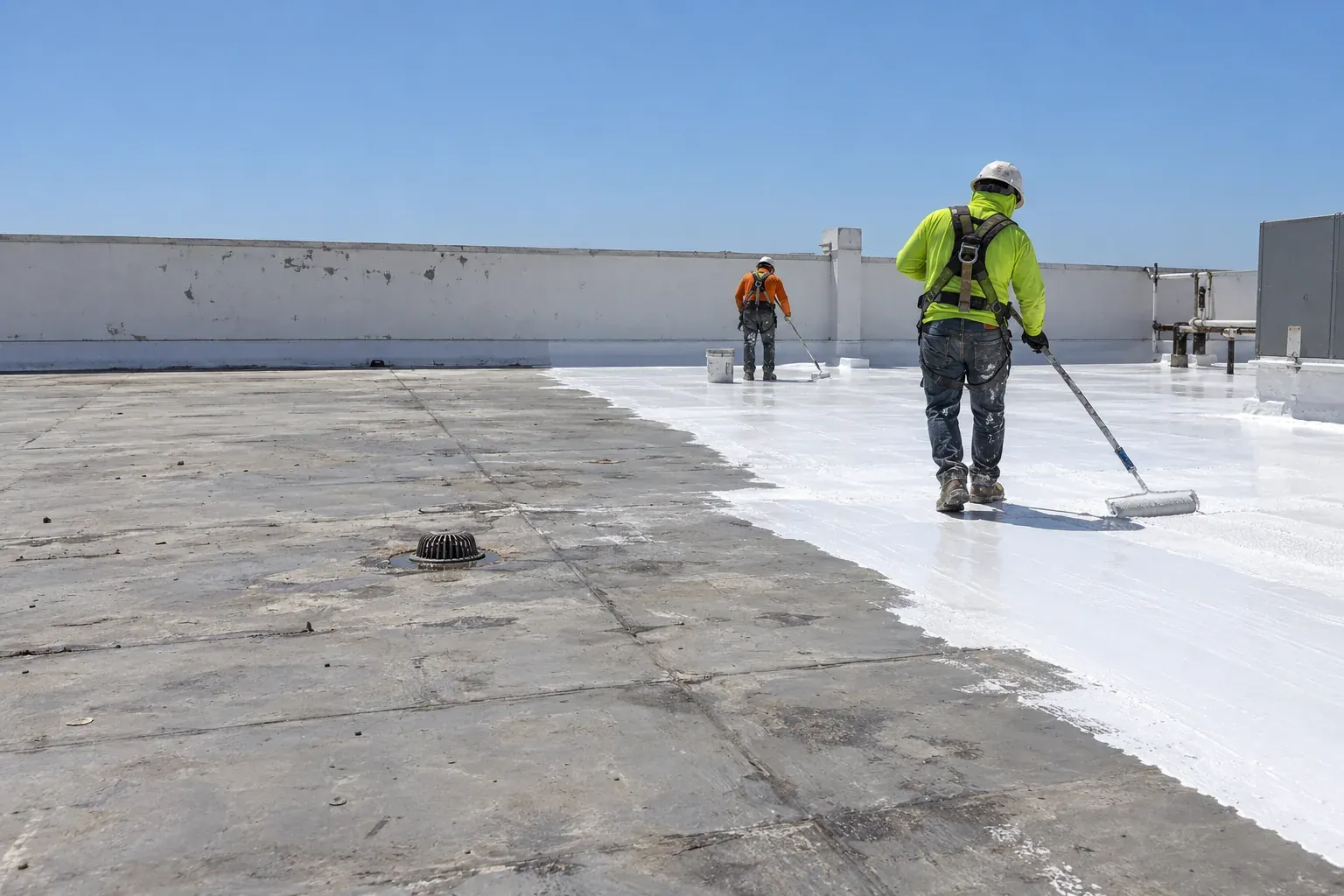
A cool roof reflects more sunlight and releases more of the heat it does absorb, compared with a standard dark roof. Three measurements describe how well it does that: solar reflectance (SR), the share of sunlight reflected rather than absorbed; thermal emittance (TE), how readily the surface releases absorbed heat; and Solar Reflectance Index (SRI), a combined score built from both. Qualifying products are independently tested and labeled by the Cool Roof Rating Council (CRRC), so a "cool roof" claim on a product is verifiable rather than a marketing term.
Cool Roof Coatings: Silicone vs Acrylic
On an existing low-slope roof, a coating is usually the fastest way to add cool-roof performance without a full re-roof. The two common choices behave differently over time:
Silicone. Resists UV degradation without chalking or becoming brittle, and tolerates continuous ponding water, even for weeks. Costs roughly 1.5 to 2 times as much as acrylic per gallon.
Acrylic. Water-based and less expensive, but most acrylic coating warranties specifically exclude ponding-water conditions, since standing water breaks the coating down faster.
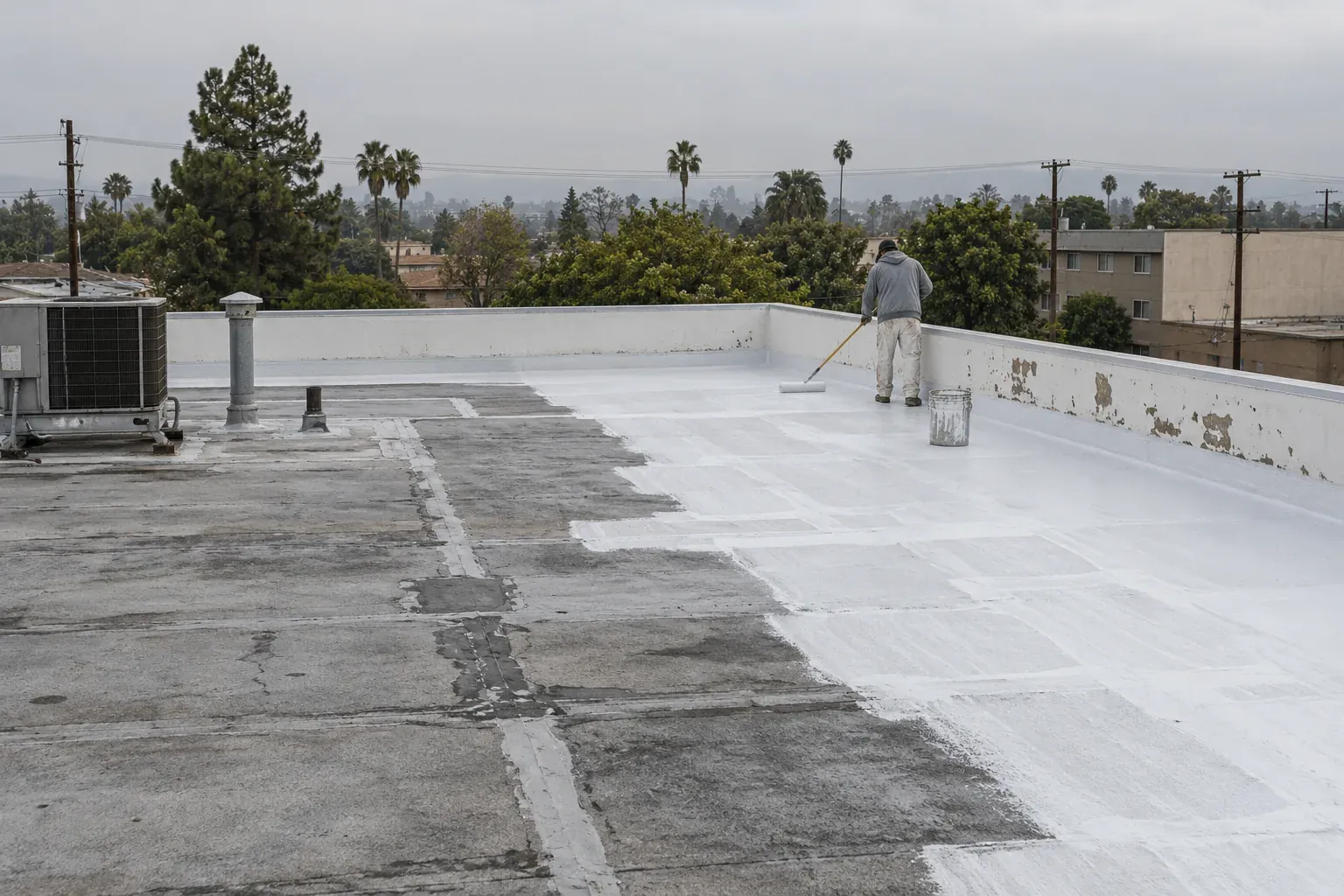
A silicone restoration going over an aged membrane. Silicone tolerates ponding water; most acrylic warranties exclude it.
When Title 24 Requires a Cool Roof
Commercial & Nonresidential Low-Slope
Any nonresidential low-slope reroof, in every California climate zone, needs a cool-roof product once the project passes 50% of the roof area or 2,000 sq ft (whichever is less): aged solar reflectance 0.63, thermal emittance 0.75, or SRI 75, with limited exceptions. Multifamily low-slope reroofs are covered in Climate Zones 2, 4 and 6 through 15 with the same trigger, and multifamily steep-slope in Zones 4 and 8 through 15. See commercial roofing in Los Angeles for the rest of the commercial code picture.
Residential Low-Slope
Residential low-slope reroofs need a cool-roof product in Climate Zones 4 and 6 through 15, which covers all three LA climate zones — 6 (coastal), 8 (South/East LA) and 9 (San Fernando Valley). The threshold is aged solar reflectance 0.63, thermal emittance 0.75 and SRI 75, and roof-deck insulation can substitute.
Residential Steep-Slope
Residential steep-slope reroofs (shingle-style) only require a cool-roof product in Climate Zones 4 and 8 through 15. That covers Zones 8 and 9 but not coastal Zone 6, so a single-family shingle reroof in coastal Zone 6 has no cool-roof requirement, while the same reroof in the San Fernando Valley does. The steep-slope threshold is aged solar reflectance 0.20, thermal emittance 0.75 and SRI 16. Exceptions include R-38 ceiling insulation, a radiant barrier, and roofs of 25 lb/sq ft or more.
Source: Cool Roof Rating Council, 2022 Title 24 Part 6 Cool Roof Summary. The 2025 Energy Code applies to permits applied for since January 1, 2026, and the reroof values are unchanged from the 2022 cycle. The thresholds are the same in every covered zone; the zone only decides whether a rule applies. In LA, coastal areas are Zone 6, South/East LA, Inglewood, Culver City and inland South Bay ZIPs are Zone 8, the San Fernando Valley is Zone 9 and the mountains are Zone 14 or 16; the California Energy Commission's climate-zone lookup is the authority for any parcel. Full rules: Title 24 cool roof rules guide.
Cool Shingles, Tile, Metal & Membranes
Cool Shingles
Reflective granules raise an asphalt shingle's solar reflectance versus a standard dark shingle, at little or no cost premium on a CRRC-rated line. See shingle roofing in Los Angeles. Other materials and services are on Roofing Los Angeles.
Cool Metal Finishes
Standing seam and stone-coated steel panels commonly use a factory Kynar 500 or Hylar (PVDF) finish, the standard coating manufacturers use to reach a reflective, CRRC-ratable surface. See metal roofing in Los Angeles.
Cool Tile
Lighter-colored clay and concrete tile can also carry cool-roof-rated finishes, an option worth discussing on a Zone 8 or 9 tile reroof. See tile roofing in Los Angeles.
Cool Membranes
TPO and PVC membranes are naturally light-colored and widely available in cool-roof-rated versions, common on both residential low-slope sections and commercial buildings. See flat roofing in Los Angeles.
The LADWP Cool Roof Rebate
The LADWP Cool Roof Rebate is active for 2026 through the Consumer Rebate Program (CRP), for LADWP residential customers with active electric service. Commercial cool-roof projects route through a separate program, LADWP's Custom Performance Program (CPP), not the residential CRP.
Base rebate: $0.20 per sq ft.
Enhanced rebate: up to $0.60 per sq ft for higher-SRI qualifying products.
Cap: $1,800 per household.
Eligibility: the roof product must meet the LA Green Building Code's 3-year-aged SRI standard per CRRC. The rebate applies only to conditioned-space roof area — patios, carports and unconditioned overhangs are excluded. Your application needs a paid itemized invoice showing the CRRC Product ID, the final approved permit, and your LADWP bill, postmarked within 12 months of purchase. Funds are first-come, first-served, so approval isn't assured.
Typical national ranges reported by roofing cost guides (2025–2026). No LA-specific coating ranges are published; these figures are before any LADWP rebate.
Cool shingles, cool tile and cool metal generally cost about the same as their standard equivalents, since the reflective treatment is part of the factory finish rather than an added step. It's really only a coating on an existing membrane roof where cool-roof compliance adds a distinct line item, and that's exactly what the LADWP rebate is built to offset.
Commercial Cool Roofing
For warehouses, retail, office and multifamily buildings, cool-roof compliance is usually decided at the same time as a repair-restore-replace call on the roof overall — a coating that adds cool-roof performance often doubles as the restoration itself. See commercial roofing in Los Angeles for the full repair, restoration and replacement picture, and how it fits your building's cost and timeline.
Cool Roof FAQs
What is a cool roof?
A cool roof uses a reflective surface, coating or membrane to reflect more sunlight and release more heat than a standard dark roof, so the roof surface and the building underneath stay cooler. Performance is measured by solar reflectance (SR), thermal emittance (TE) and Solar Reflectance Index (SRI), and qualifying products are labeled and verified by the Cool Roof Rating Council (CRRC).
Is a cool roof required in California?
It depends on the building and roof type. Under Title 24, nonresidential low-slope reroofs need a cool roof in every California climate zone once the project passes a size threshold. Residential requirements vary by roof slope and climate zone: LA's low-slope residential reroofs are covered in all three LA zones (6, 8 and 9), while steep-slope (shingle-style) single-family reroofs are only required to be cool-rated in Zones 4 and 8 through 15, which includes LA's Zones 8 and 9 but not coastal Zone 6. The 2025 Energy Code, in force for permits applied for since January 1, 2026, left the reroof values unchanged.
How much does a cool roof cost?
Cool shingles, tile and metal generally cost about the same as their standard equivalents, since the reflective treatment is part of the factory finish. Adding a cool coating to an existing roof runs about $0.50 to $3.50 per square foot for acrylic and about $1.50 to $7 per square foot for silicone, depending on the substrate.
Silicone or acrylic roof coating — which is better?
It depends on the roof. Silicone resists UV degradation without chalking or embrittling, and tolerates continuous ponding water, even for weeks, while most acrylic coating warranties specifically exclude ponding conditions. Silicone typically costs 1.5 to 2 times as much as acrylic per gallon, so acrylic remains a reasonable choice on a well-drained roof with no ponding history.
Do cool roof shingles actually work?
Cool-rated shingles use reflective granules to raise solar reflectance versus a standard dark shingle, and CRRC-rated products are independently tested and labeled with their initial and aged reflectance and emittance values, rather than relying on manufacturer marketing claims alone.
What's the difference between a "cool roof" and a "cold roof"?
They're unrelated concepts that get confused because of the similar names. A cool roof is about the roofing material's reflectivity, reducing heat absorbed from the sun. A cold roof is a ventilation design, where an air gap between the insulation and the roof deck keeps the deck close to outdoor temperature to prevent ice damming and condensation, a bigger concern in snow climates than in LA.
Can I get a tax credit for a cool roof in California?
There's no cool-roof-specific federal tax credit currently available. The federal residential solar credit is unrelated to roofing material and, separately, was ended for anything placed in service after December 31, 2025. For cool roofs specifically, the LADWP Cool Roof Rebate is the main local incentive for eligible LADWP customers.
Find out what your cool roof project qualifies for
Tell us about the building, the roof type, and whether this is a repair, a coating or a full reroof. A contractor can walk you through Title 24 compliance, LADWP rebate eligibility, and a written cost estimate.