Both materials show up across LA's tile roofs, and the choice usually comes down to weight, cost and the look you're matching. Clay is the lighter, longer-lived, more traditional option; concrete is heavier, generally less expensive per tile, and available in a wider range of colors and profiles, including flat styles that don't read as "Spanish" at all.
Concrete tile is roughly 40% heavier than clay on average. Standard California roof framing usually carries clay tile without modification, while heavier concrete tile can require structural reinforcement, and clay's lighter weight is also cited as a modest advantage under seismic load. Lightweight concrete tile formulations exist for structures that can't take standard-weight concrete without reinforcement. For how tile stacks up against shingle, metal and flat roofing generally, see our guide to the best roofing materials for Southern California.
Material
Weight
Typical lifespan
Clay tile
~6–10 lb/sq ft
50–100+ years (the tile; underlayment usually needs replacing sooner)
LA's Tile Profiles: Mission, Barrel, S-Tile and Flat Concrete
Three profiles cover most LA tile roofs. Two-piece Mission (or barrel) tile uses a concave pan tile and a convex cap tile that interlock, giving the deep, shadowed look on 1920s–1930s Spanish Revival homes. One-piece S-tile mimics that same barrel profile in a single interlocking unit, which installs faster and costs less. Flat concrete tile reads more like textured slate or shake and shows up on newer builds and tract homes. All three come in clay or concrete, and matching a repair or addition to the roof's existing profile matters more for shedding water than it does for looks.
Signs Your Tile Roof Needs Attention
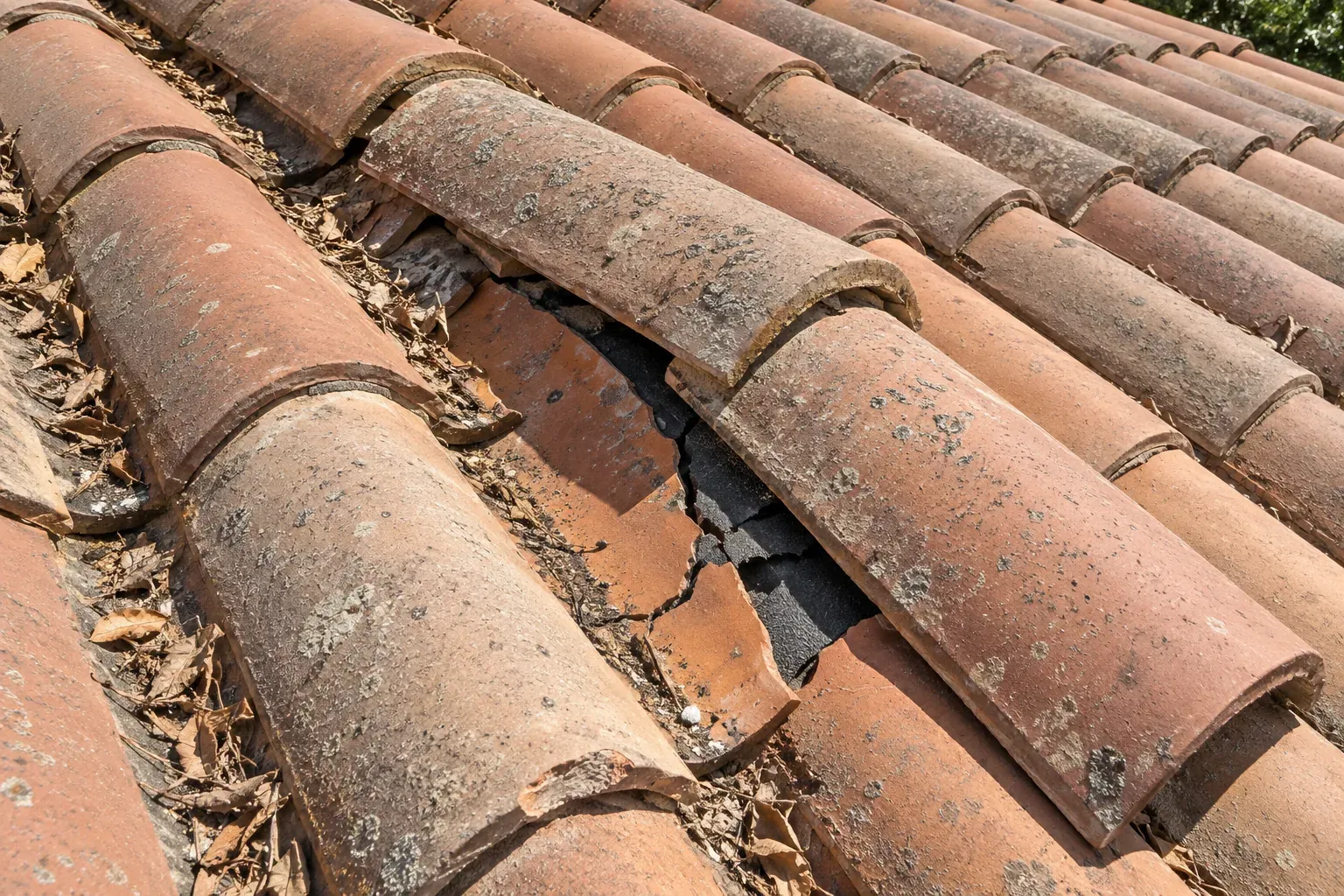
Slipped or cracked tiles. Usually from foot traffic, settling or age; each exposed spot lets sun and rain reach the underlayment years early.
Water stains or drips inside that don't line up with where a tile is visibly out of place. Water often travels along the underlayment or rafters before it shows up on a ceiling.
Faded, brittle-looking underlayment visible wherever a tile has slipped or is missing.
Moss or heavy dirt buildup holding moisture against the tile, usually on shaded, north-facing slopes.
A roof original to a pre-1980s house that's never had the underlayment replaced, even if the tile itself still looks sound.
A slipped or cracked tile exposes the underlayment beneath it to direct sun and rain.
Tile Repair
Isolated damage is usually a straightforward repair: lift the tiles around the affected spot, patch or replace the underlayment section underneath, and relay the original tiles, using matched salvage tile wherever one has cracked. Because clay and concrete tile is fragile underfoot, a good repair is done from ladders and tile-walking boards that spread the roofer's weight across the battens rather than the center of a single tile, so fixing one problem doesn't create new cracks nearby. Leaks that trace back to flashing at a chimney or skylight rather than the tile field are covered on our roof repair in Los Angeles page.
Lift-and-Relay: Replacing the Underlayment Without New Tile
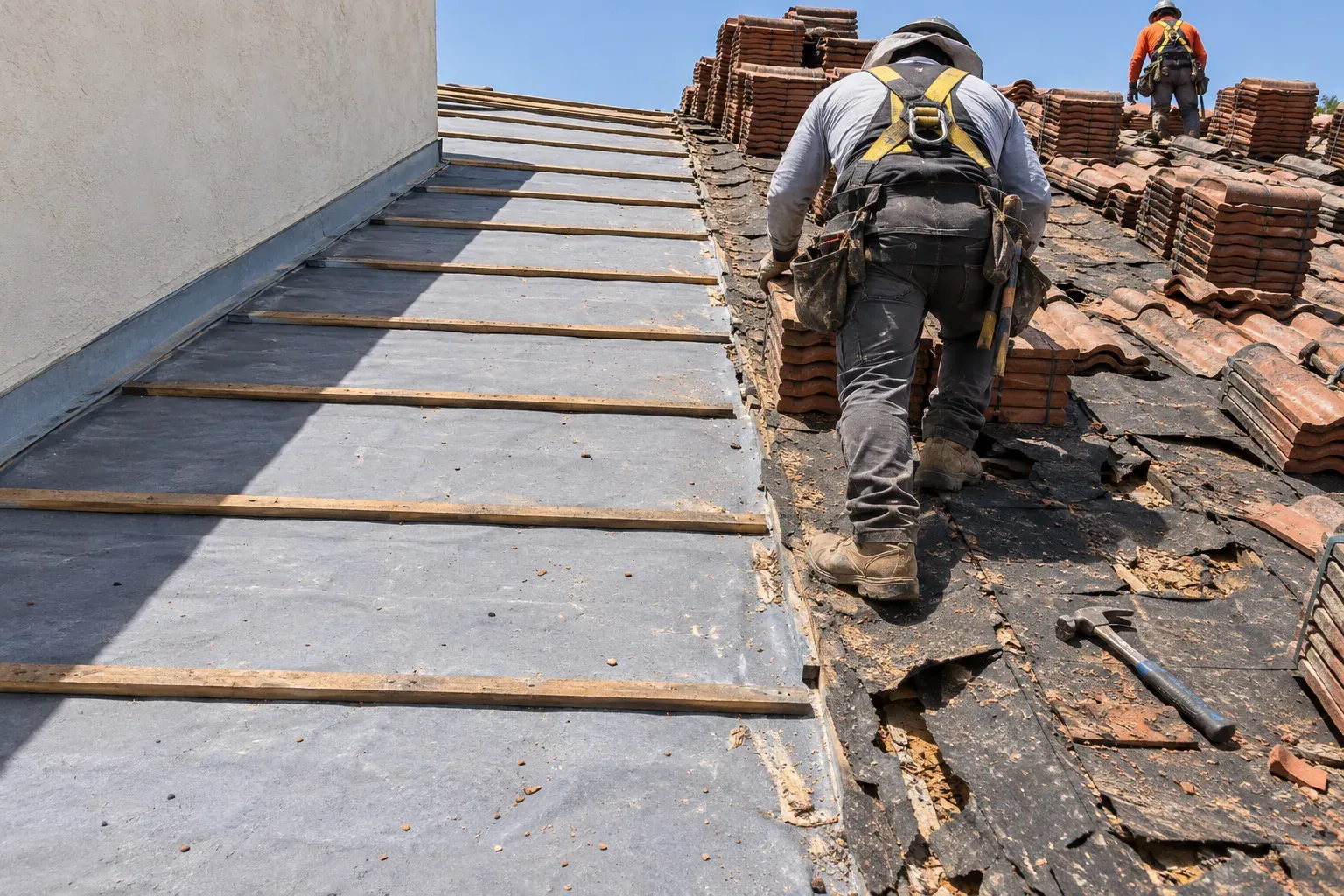
If the tile is sound but the underlayment beneath it has failed across a wide area, the fix is a lift-and-relay: the existing tile is lifted off and staged, the old felt or synthetic underlayment is torn out and replaced, and the same tiles are reset. A quote should include a tile-breakage allowance, since some tiles crack during removal even when handled carefully.
Item
Typical cost
Lift-and-relay, installed (labor + materials, plus a breakage allowance)
~$3–$6/sq ft, or ~$6,000–$12,000 for a 2,000 sq ft roof
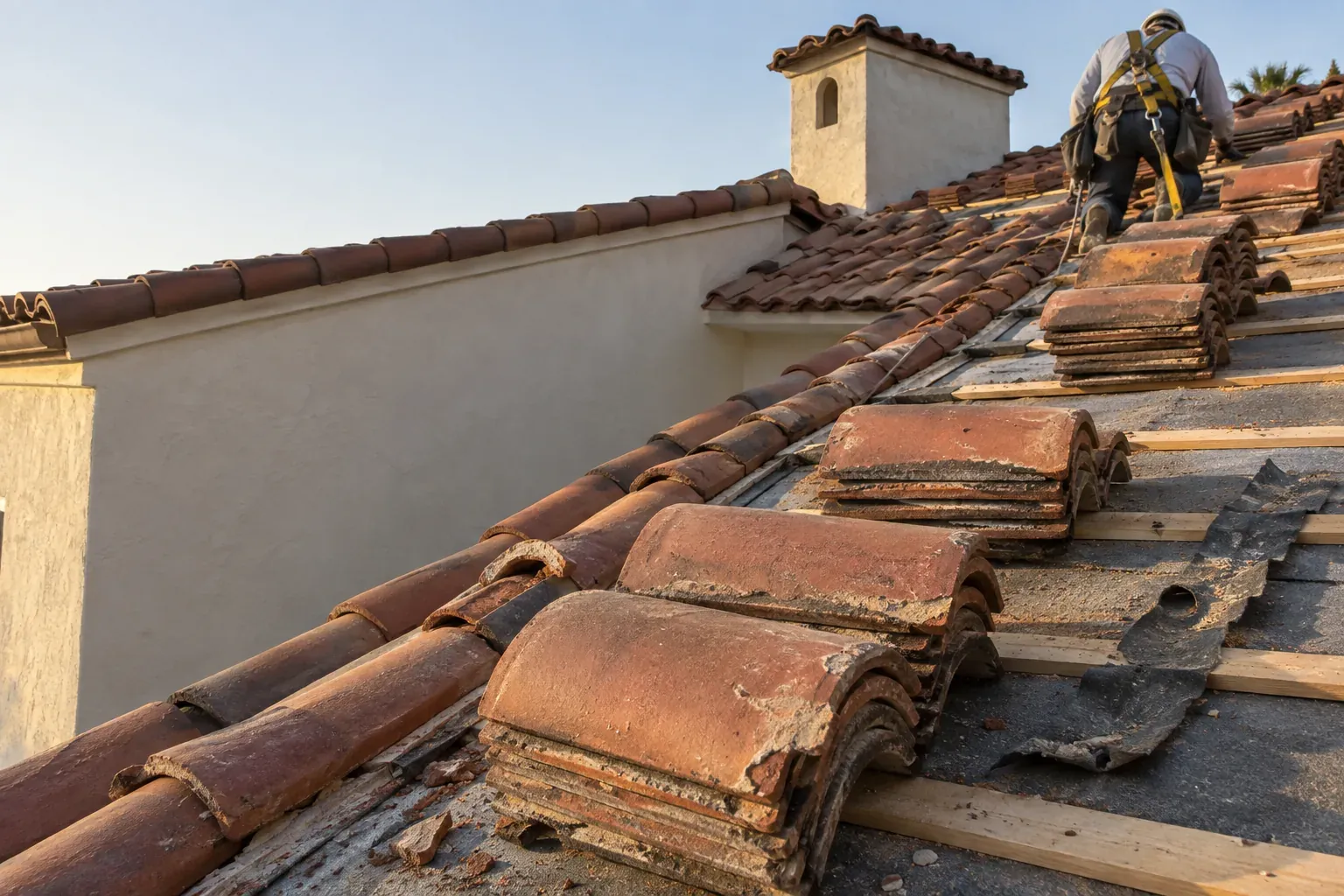
A lift-and-relay in progress: tile removed, staged, and reset on new underlayment.
Reusing Salvaged Tile
Reusing the existing tile is standard practice on a lift-and-relay or a partial repair, especially on older homes where the original clay tile's color or profile has been discontinued. Sound tiles come off, get staged, and go back on; broken tiles are replaced with matching salvage tile wherever it can be sourced, with new tile used only where nothing else fits. Ask your contractor how they're sourcing replacement tile before assuming a full re-tile is the only option.
A full tear-off and replacement makes sense when both the tile and underlayment have failed together — usually a roof original to the house and now 40 to 50-plus years old — or when storm or settling damage has broken tile across large sections rather than isolated spots. Replacement tile can match the existing profile, or move from standard-weight concrete to lighter clay or a lightweight concrete formulation where the structure calls for it. A full tile roof replacement in LA typically runs about $12 to $25 per square foot installed, or roughly $24,000 to $50,000 for about 2,000 sq ft of roof, according to published 2026 cost guides (SilverHammer Builders, RoofVista). For lifespan across materials, see how long does a roof last in LA. If tile isn't the right fit, compare all your options at Roofing Los Angeles.
Fire Rating in LA's Hazard Zones
Class A Roof Assemblies
Roofs in a Fire Hazard Severity Zone need a Class A-rated assembly. Concrete and clay tile are both commonly used Class A materials, along with metal and Class A-listed composition shingles; the whole roof assembly has to carry the rating, not just the surface layer. CAL FIRE released updated Los Angeles-area hazard zone maps on March 24, 2025, adding parcels that weren't previously in a designated zone, so it's worth checking whether your address changed before assuming your roof doesn't need to meet Class A.
How a Tile Roof Should Be Assessed
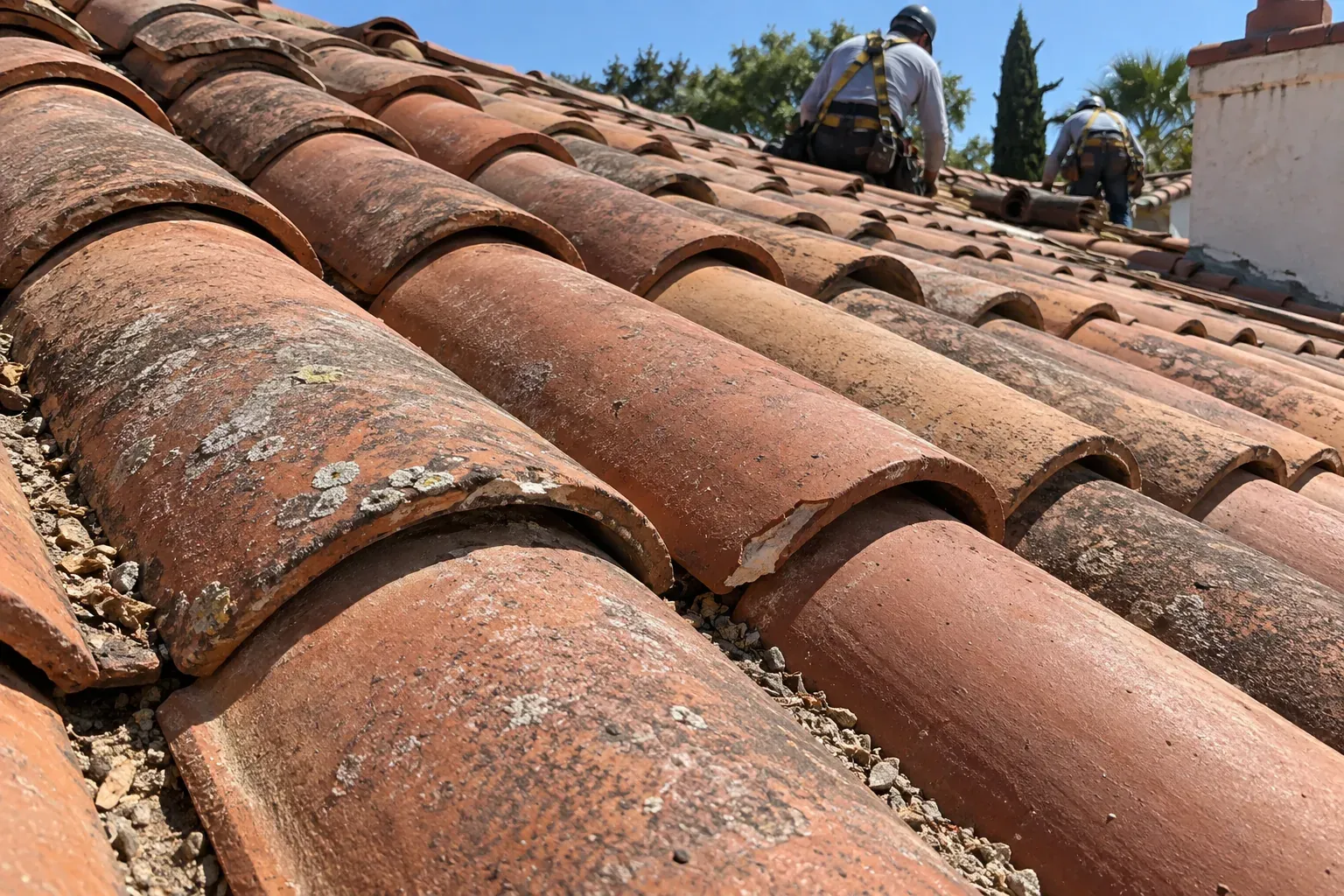
Close inspection of the tile shows how much life the roof has left.
Inspect from the tile downThe roofer should lift sample tiles across different roof slopes and check the underlayment condition, not just what's visible from the ground or a drone photo.
Show you the evidencePhotos of slipped tile, failed underlayment and any deck damage, before recommending anything.
Give you a written scopeRepair, lift-and-relay or replacement, with the tile source (salvaged vs new) and the price, so you can compare quotes on the same terms.
Work the roof correctlyTile is walked on batten lines with load-spreading boards, not stepped on directly, to avoid creating new cracks during the work.
Tile Roofing FAQs
What are Spanish-style roof tiles called?
Two main profiles cover most Spanish-style LA roofs: two-piece Mission (or barrel) tile, made of separate concave pan tiles and convex cap tiles, and one-piece S-tile, which mimics the same barrel shape in a single interlocking unit. Both come in clay or concrete.
How much does a tile roof cost in Los Angeles?
A full tile roof replacement in LA typically runs about $12 to $25 per square foot installed, or roughly $24,000 to $50,000 for about 2,000 sq ft of roof, depending on tile type, roof complexity and access. Repair and lift-and-relay work is priced separately and usually costs far less than a full replacement.
Can I walk on a tile roof?
Only carefully. Clay and concrete tile cracks under concentrated weight, so a roofer walks batten lines near the eaves rather than the center of a tile, and often uses load-spreading boards. If you need to check something on a tile roof yourself, it's safer to look from a ladder at the eave line than to walk the field.
What's the difference between clay and concrete roof tile?
Clay tile weighs about 6 to 10 pounds per square foot and concrete tile about 9 to 12 (lightweight concrete formulations run 6 to 7). Concrete is roughly 40% heavier than clay on average, so standard California framing usually carries clay without modification while heavier concrete tile can require structural reinforcement.
Do I need to replace the tile, or just the underlayment?
Often just the underlayment. Tile frequently outlasts the felt or synthetic underlayment beneath it. A lift-and-relay removes the tile, replaces the failed underlayment, and resets the same tiles, which is typically far cheaper than a full re-tile. See our tile roof underlayment guide for the full process.
Can slipped or cracked tiles be repaired without replacing the whole roof?
Yes. Isolated slipped or cracked tiles are a standard repair: the affected tiles come off, the underlayment underneath is checked and patched if needed, and the original tiles go back on, with matching salvage tile used for anything that broke.
Is a tile roof Class A fire-rated?
Concrete and clay tile are both commonly used Class A materials, required for roofs in a Fire Hazard Severity Zone. The whole roof assembly has to carry the rating, not just the tile surface, so installation details matter as much as the material choice.
Get your tile roof assessed properly
Tell us what you're seeing — slipped tile, a stain inside, or just an old roof you want checked before the rainy season. A good roofer shows you photos of what they find and writes up a scope for repair, lift-and-relay or replacement before anything starts.