Serving homes and buildings across Los Angeles County Free estimates Written line-item quotes
Roofing Los AngelesRoof repair & replacement Free estimate
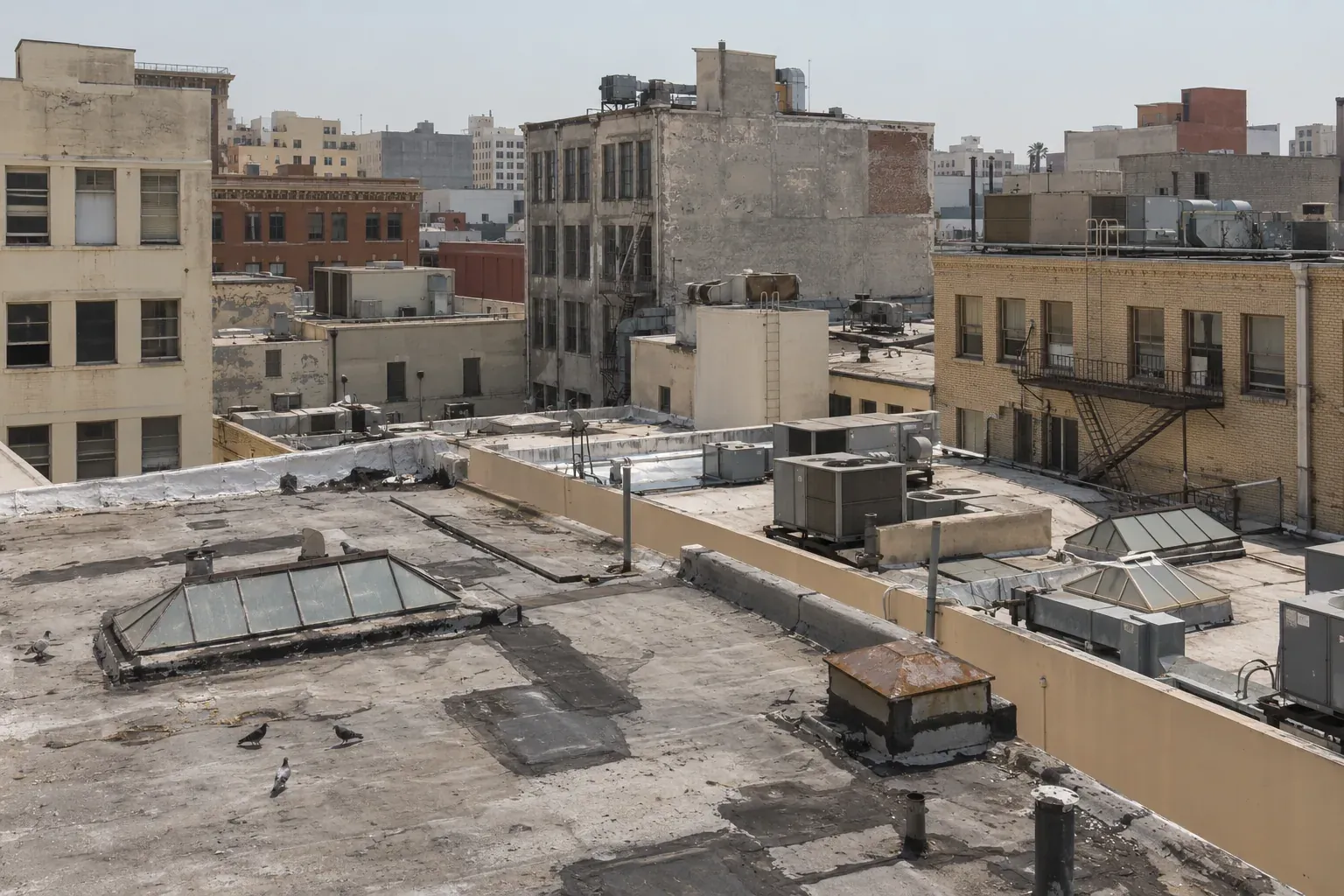
Flat commercial rooftops, typical of Downtown Los Angeles

Roofing in Downtown Los AngelesFlat Roofs, Old Masonry and Loft Conversions

Most Downtown reroof work is commercial low-slope: membrane and built-up roofs rather than shingle or tile, filed with a permit office that sits inside the neighborhood.

What's going on with your Downtown LA roof?

A ZIP code is enough to get started.

Once you have filled it in, one of our contractors will reach out to you ASAP.

  • Free estimates
  • Written line-item quotes
  • Photos of the roof before any work
  • Permits pulled where required

Why Downtown Roofs Are Mostly Flat

Downtown's roofline mixes pre-1930s masonry commercial buildings (the Alexandria Hotel from 1906, the Rosslyn from 1911, the Biltmore from 1923), post-1999 adaptive-reuse loft conversions, and high-rises built after the city lifted its 150-foot height limit in 1957. Older Bunker Hill mansions are mostly gone, so what's left is dense mid-rise and high-rise stock.

Reroof work here is overwhelmingly commercial low-slope: TPO, PVC, modified bitumen or built-up roofing, not the tile and shingle jobs that dominate the hillside and Valley neighborhoods.

Permits Through the Metro DSC

The Metro (Downtown) Development Services Center, at 201 and 221 N. Figueroa St., sits inside the neighborhood and is LADBS's flagship office. Most reroofs still get filed the same way as anywhere else: an Express Permit through PermitLA for Class A or B material under 6 lb per sq ft over existing sheathing, no plan check required.

Downtown zips 90012, 90013, 90014, 90015, 90017 and 90021 are in Title 24 Climate Zone 9. The low-slope cool-roof rule covers the flat and built-up roofs that dominate here, and for nonresidential and multifamily buildings it applies when more than 50% of the roof or 2,000 sq ft, whichever is less, is replaced, recovered or recoated.

Cool Roof Rebate: Two Different Doors

LADWP's residential Consumer Rebate Program is built for homes. Commercial cool-roof projects, which is most of Downtown, route through LADWP's separate Custom Performance Program instead. The Title 24 guide has the residential terms.

Notice

Vinegar Hill HPOZ vs. the Historic Core

Two labels get confused Downtown. The small Vinegar Hill HPOZ, one of the city's smallest, is a genuine Historic Preservation Overlay Zone, meaning real roof-material design review on contributing structures. The Historic Core along Broadway is on the National Register, a federal listing rather than a City HPOZ, so it doesn't carry the same automatic review. If you're not sure which applies, confirm with LA City Planning first.

Downtown is flat urban terrain with no hillside interface, so it sits outside the city's Very High Fire Hazard Severity Zone layer, unlike the hills to the north and east.
Common Roofs in Downtown LA

Whether an old membrane needs a coating or a full tear-off depends on its condition; the repair-or-replace guide covers the decision.

Downtown LA Roofing FAQs

Who issues roofing permits in Downtown LA?

The Metro (Downtown) Development Services Center, at 201 and 221 N. Figueroa St., is LADBS's flagship office and sits inside the neighborhood. LADBS describes it as its largest center. For most reroofs using Class A or B material under 6 lb per sq ft over existing sheathing, you can file an Express Permit online through PermitLA without a plan check.

Does the Title 24 cool-roof rule apply to a Downtown LA building?

Usually, on a low-slope roof. For nonresidential and multifamily buildings the rule applies when more than 50% of the roof, or 2,000 sq ft, whichever is less, is replaced, recovered or recoated. The aged reflectance and emittance values are the same in every covered zone, and the nonresidential low-slope rule covers all zones. Commercial cool-roof projects seeking an LADWP incentive route through its Custom Performance Program, not the residential rebate.

Is my building in a historic district that affects reroofing?

Depends where. The small Vinegar Hill HPOZ is a genuine regulatory overlay with design review. The Historic Core, covering much of Broadway's pre-1930s commercial stock, is on the National Register but is not itself an HPOZ, so it does not carry the same roof-material review by default. Confirm your specific parcel with LA City Planning before assuming either way.

Is Downtown LA in a fire hazard zone?

No. Downtown sits on flat urban terrain with no hillside or brush interface, so it falls outside the city's Very High Fire Hazard Severity Zone layer. Class A roofing isn't a fire-zone requirement here the way it is in the hills.

What kind of roof does a typical Downtown LA building have?

Flat or low-slope. Downtown's stock runs from pre-1930s masonry commercial buildings to post-1999 loft conversions and newer high-rises, and most reroof work here is a membrane or built-up system rather than pitched shingle or tile. That's a different maintenance and cool-roof conversation than a single-family home.

Next Door to Downtown

Koreatown, to the west, has a similar low-slope multifamily stock. Echo Park, to the northwest, is hillside housing where the roofs and permits differ a lot. See every area on the areas page. Building owners with properties outside downtown can compare services at Roofing Los Angeles.

Old membrane on a Broadway-era building? Describe the roof.

Tell us the building type and what you're seeing on the roof.

A ZIP code is enough to get started.

Once you have filled it in, one of our contractors will reach out to you ASAP.

Tell us about your roof