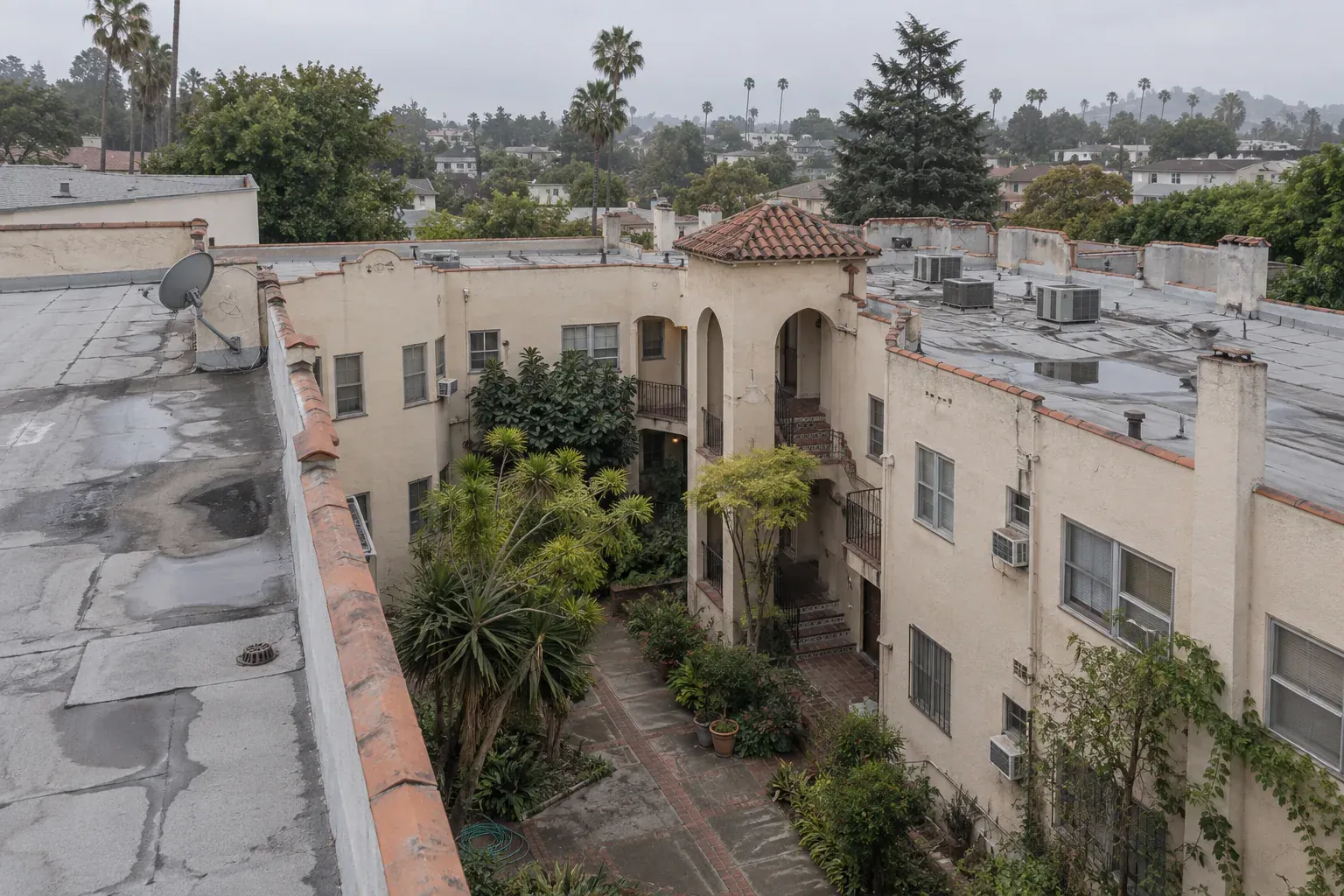
Roofing in KoreatownDense, Low-Slope and Mostly Multifamily
Koreatown is one of the densest parts of LA, and most of its roofs sit on courtyard apartments and mixed-use buildings, not single-family homes. That changes which rules and which rebate apply.
What's happening with your Koreatown building's roof?
Free estimates
Written line-item quotes
Photos of the roof before any work
Permits pulled where required
A Dense, Renter-Heavy Roofscape
Koreatown's housing is dominated by mid-20th-century multifamily construction: courtyard apartments and 1960s–80s low-rise buildings, with older Art Deco commercial stock lining Wilshire and Western. Roughly 93% of housing here is renter-occupied, and the neighborhood is among the most densely populated in the country. Closely spaced buildings and tight lots constrain roof access and material staging in a way single-family neighborhoods don't have to plan around.
Permits and Climate Zone
There's no LADBS office boundary map that assigns Koreatown to one specific Development Services Center, but that rarely matters in practice: reroof permits go through LADBS citywide, and most jobs get filed as an Express Permit online via PermitLA.
The 90004, 90005 and 90006 zip codes are all Title 24 Climate Zone 9, where the low-slope cool-roof rule applies to multifamily and nonresidential reroofs.
Cool Roof Rule, Multifamily Track
Apartment buildings are multifamily under Title 24, not nonresidential and not single-family. A low-slope multifamily reroof triggers the cool-roof rule when more than 50% of the roof, or 2,000 sq ft, whichever is less, is altered. LADWP routes commercial cool-roof projects through a separate program from the residential rebate, so ask which one a building qualifies for.
No HPOZ Over the Core, but Notable Art Deco Stock
No City HPOZ covers the Koreatown core. What the neighborhood does have is a run of Art Deco terra-cotta commercial buildings along Wilshire and Western that have stayed in economic use without formal preservation status. A building near the neighborhood's edge is worth checking against LA City Planning's HPOZ map, since the boundary between Koreatown and its neighbors isn't fixed.
Koreatown is flat, dense urban terrain with no hillside exposure, so it falls outside the city's Very High Fire Hazard Severity Zone layer.
Ground-floor retail under residential units usually means a shared low-slope roof managed by a property manager or HOA. See commercial roofing.
Older Art Deco commercial buildings
The roofs on these older buildings are a separate question from the apartments around them: whether a coating or a replacement makes sense depends on the membrane's condition and how much moisture it has taken on.
If you manage a building here and aren't sure whether a leak needs a patch or a section replaced, describe the roof in the form above.
Koreatown Reroofs Are Mostly Apartment Roofs
Of the 331 reroof permits LADBS issued in Koreatown from 2020 through 2025, 56% were for apartment buildings, more than four times the citywide share of 13%. Those roofs are bigger, too: the median permit here covers 31 squares, against 23 citywide. On a low-slope apartment roof, that size puts most jobs over the multifamily cool-roof trigger of 50% of the roof or 2,000 sq ft, whichever is less.
Reroof permits
Koreatown
City of LA
Reroof permits issued, 2020–2025
331
70,049
Average per year
55
11,675
Median roof size on the permit
31 squares
23 squares
Went over new solid sheathing
18%
21%
On a city-designated hillside lot
0%
20%
On an apartment building
56%
13%
Tile lift-and-relay permits, 2020–2026
7
1,682
Issued as an Express Permit
100%
99%
Koreatown here means the Wilshire Center-Koreatown Neighborhood Council area. Data: LADBS permits via data.lacity.org (pi9x-tg5x), through 9/26/2026; roof size and sheathing counted where the permit states them. Check your own roof with the permit checker.
Koreatown Roofing FAQs
Who issues a roofing permit in Koreatown?
LADBS citywide. Koreatown doesn't have its own Development Services Center inside the neighborhood, but that doesn't slow things down: most reroofs are filed as an Express Permit online through PermitLA regardless of which office is technically nearest, using an Angeleno Account.
Does the Title 24 cool-roof rule apply to my Koreatown apartment building?
Almost certainly, on a low-slope roof. Apartment buildings are multifamily under Title 24, and the multifamily low-slope rule applies in Koreatown's zone 9 when more than half the roof, or 2,000 sq ft, whichever is less, is replaced, recovered or recoated. It isn't the single-family steep-slope rule.
Does a tight Koreatown lot change how a roof job gets done?
It can. Koreatown is one of the densest neighborhoods in the country, and closely spaced buildings limit roof access and where materials can be staged. On a low-slope roof job, ask how materials get to the roof and where they'll sit before the crew arrives.
Is there a historic district covering Koreatown?
No City HPOZ covers the Koreatown core itself. The neighborhood is known for Art Deco terra-cotta commercial buildings along Wilshire and Western that have stayed economically viable without formal preservation status. For a building near the edge of the neighborhood, check LA City Planning's HPOZ map.
Is Koreatown in a fire hazard zone?
No. Koreatown is flat, dense urban terrain with no hillside or brush exposure, so it sits outside the city's Very High Fire Hazard Severity Zone layer.
Next Door to Koreatown
Head east along Wilshire to Downtown LA, or just south to Mid-City; both have a similar mix of low-slope multifamily and commercial roofs. See every neighborhood on the areas page. For services beyond Koreatown, see Roofing Los Angeles.
Flat roof over a courtyard building? Tell us what the roof is doing.